
Overview
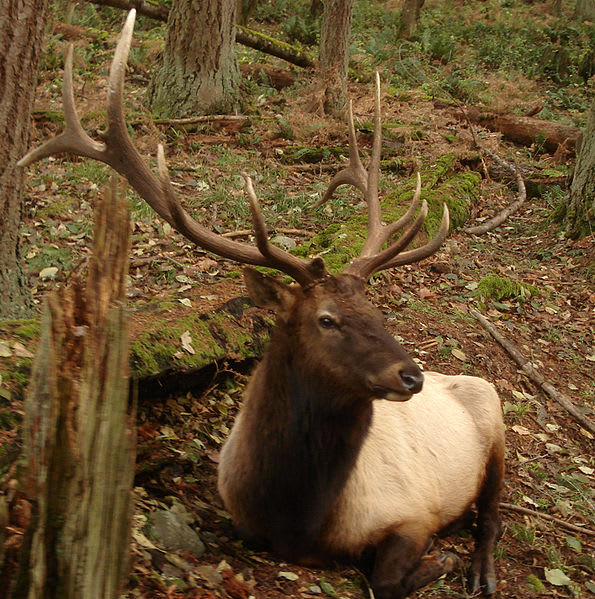
Elk are more than twice as heavy as mule deer and have a more reddish hue to their hair coloring, as well as large, buff-colored rump patches and smaller tails. Moose are larger and darker than elk; bulls have distinctively different antlers. Bulls are some 40% larger than cows at maturity. The largest of the subspecies is the Roosevelt elk (C. c. roosevelti). The smallest-bodied race is the tule elk (C. c. nannodes). During the fall, elk grow a thicker coat of hair, which helps to insulate them during the winter. Males, females and calves of the Northern elk group all grow thin neck manes; female and young Manchurian and Alaskan specimens do not. By early summer, the heavy winter coat has been shed, and elk are known to rub against trees and other objects to help remove hair from their bodies. All elk have small and clearly defined rump patches with short tails. They have different coloration based on the seasons and types of habitats, with gray or lighter coloration prevalent in the winter and a more reddish, darker coat in the summer. Subspecies living in arid climates tend to have lighter colored coats than do those living in forests. Most have lighter yellow-brown to orange-brown coats in contrast to dark brown hair on the head, neck, and legs during the summer. Forest-adapted Manchurian and Alaskan specimens have darker reddish-brown coats with less contrast between the body coat and the rest of the body during the summer months. Calves are born spotted, as is common with many deer species, and they lose their spots by the end of summer. Adult Manchurian wapiti may retain a few orange spots on the back of their summer coats until they are older. This characteristic has also been observed in the forest-adapted European red deer.
Taxonomy
- Kingdom
- Animalia
- Phylum
- Chordata
- Class
- Mammal
- Order
- Artiodactyla
- Family
- Cervidae
- Genus
- Cervus
Habitat
Forest and forest-edge habitat. Prefer areas with altitude. As is true for many species of deer, especially those in mountainous regions, elk migrate into areas of higher altitude in the spring, following the retreating snows, and the opposite direction in the fall. During the winter, they favor wooded areas and sheltered valleys for protection from the wind and availability of tree bark to eat. In North America they adapted to almost all ecosystems except for tundra, true deserts, and the gulf coast of the U.S. The habitat of Siberian elk in Asia is similar to that of the Rocky Mountain subspecies in North America.
Diet
They are ruminants and therefore have four-chambered stomachs. Unlike white-tailed deer and moose which are primarily browsers, elk have a similarity to cattle as they are primarily grazers, but like other deer, they also browse. Elk have a tendency to do most of their feeding in the mornings and evenings, seeking sheltered areas in between feedings to digest. Their diets vary somewhat depending on the season, with native grasses being a year-round supplement, tree bark being consumed in winter and forbs and tree sprouts during the summer. Elk consume an average of 20 lbs (9.1 kg) of various vegetation daily. Particularly fond of aspen sprouts which rise in the spring, elk have had some impact on aspen groves which have been declining in some regions where elk exist.
Behavior
Adult elk usually stay in single-sex groups for most of the year outside of mating season. During the mating period known as the rut, mature bulls compete for the attentions of the cow elk and will try to defend females in their harem. Rival bulls challenge opponents by bellowing and by paralleling each other, walking back and forth. This allows potential combatants to assess the other's antlers, body size and fighting prowess. If neither bull backs down, they engage in antler wrestling, and bulls sometimes sustain serious injuries. Bulls also dig holes in the ground, in which they urinate and roll their body. A male elk's urethra points upward so that urine is sprayed almost at a right angle to the penis. The urine soaks into their hair and gives them a distinct smell which attracts cows. Dominant bulls follow groups of cows during the rut, from August into early winter. A bull will defend his harem of 20 cows or more from competing bulls and predators. Only mature bulls have large harems and breeding success peaks at about eight years of age. Bulls between two and four years and over 11 years of age rarely have harems, and spend most of the rut on the periphery of larger harems. Young and old bulls that do acquire a harem hold it later in the breeding season than do bulls in their prime. A bull with a harem rarely feeds and he may lose up to 20 percent of his body weight. Bulls that enter the rut in poor condition are less likely to make it through to the peak conception period or have the strength to survive the rigors of the oncoming winter.
Hunting
The Rocky Mountain elk is the most numerous variety with the widest distribution, and is the one sought after by most elk hunters. The classic way to hunt elk is on horseback from a packed-in tent camp and, if one can arrange it, this is the way to go. A high mountain hunt with a good outfitter in a good area during the bugling season can be the experience of a lifetime. During the rut, bulls can be bugled in by a good caller. They can also be stillhunted, or glassed and stalked, or shot at long range. Elk are often hunted in up-and-down country, where shots are either pointblank or 300-500 yards (275-450 m) across a canyon. Elk are large, vital animals; therefore, adequate calibers and strongly constructed bullets should be used and shots should be placed well. When bowhunting elk, your best chance for success is to hunt during the rut. If it is the hot early season before the rut has hit focus on water and wallows.
Conservation Status
The Rocky Mountain elk subspecies has been reintroduced by hunter-conservation organizations in the Appalachian region of the eastern U.S., where the now extinct eastern elk once lived. After elk were reintroduced in the states of Kentucky, North Carolina and Tennessee, they migrated into the neighboring states of Virginia and West Virginia, and have established permanent populations there. In 2017, a male elk, likely from the Smoky Mountains population, was sighted in South Carolina for the first time in nearly 300 years. Elk have also been reintroduced to a number of other states, including Pennsylvania, Michigan, Wisconsin, Missouri and Etolin and Afognak Islands in Alaska. Reintroduction of the elk into Ontario began in the early 20th century, and is still ongoing due to the limited success.
Subspecies (13)
- Roosevelt elkCervus canadensis roosevelti
- Eurasian elkAlces alces alces
- Kashmir deerCervus canadensis hanglu
- Alashan wapitiCervus canadensis alashanicus
- Gansu red deerCervus canadensis kansuensis
- Manchurian wapitiCervus canadensis xanthopygus
- Manitoban elkCervus canadensis manitobensis
- Sichuan deerCervus canadensis macneilli
- Rocky Mountain elkCervus canadensis nelsoni
- Altai wapitiCervus canadensis sibiricus
- Tian Shan wapitiCervus canadensis songaricus
- Tibetan red deerCervus canadensis wallichii
- Tule elkCervus canadensis nannodes