
Overview
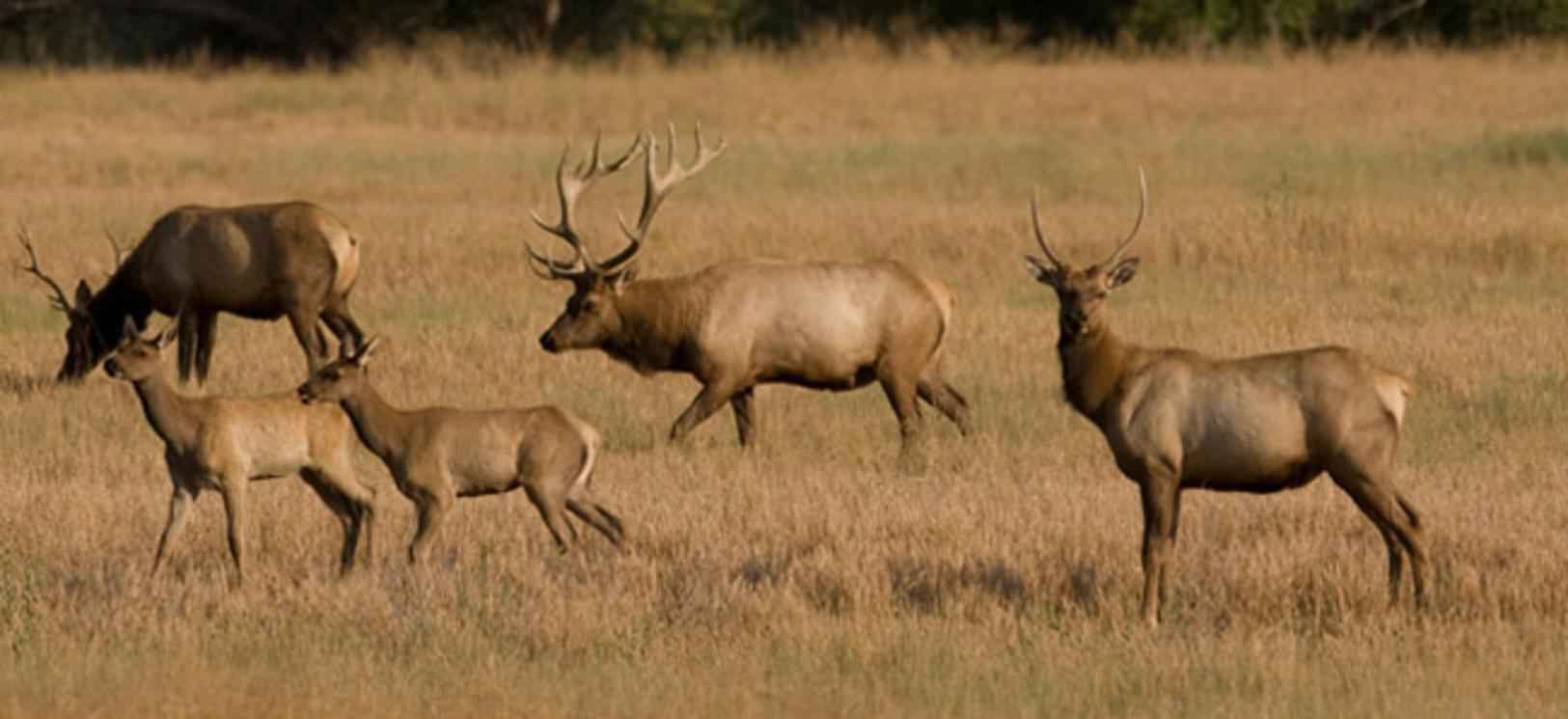
The smallest American elk, lighter in color, and with small antlers that have arched beams and tines and tend to be palmate in larger specimens.
Taxonomy
- Kingdom
- Animalia
- Phylum
- Chordata
- Class
- Mammal
- Order
- Artiodactyla
- Family
- Cervidae
- Genus
- Cervus
- Species
- Cervus canadensis
Habitat
Open country and semi-desert. Distribution- Only in California, where they originally occurred in great numbers in the broad, open valleys of the coastal and central parts of the state, where tules were the characteristic native plants. Now in several small herds (especially Cache Creek and Tupman) within the original range, and a larger transplanted population in the Owens Valley, which is outside its original range but considered indigenous for record-keeping purposes.
Diet
Tule elk both graze and browse; forbs are consumed in the spring and summer, while grasses and sedges are eaten throughout the year. These animals must drink water and usually remain within a few miles of an open water source.
Behavior
These elk are known to move across their range based on season and availability of food and water. Given the arid conditions of their habitat, sources of water are a primary factor in Tule elk movement.
Hunting
Beginning in 1988, permits have been available to California residents through drawings. In recent years, tule elk have also been available for hunting from private herds. While using bugle calls is effective during the rut as with other elk subspecies, the open and arid habitat the Tule elk inhabits requires different tactics than with other elk.
Conservation Status
Elk as an entire species are listed as Least Concern by IUCN. Tule elk numbers declined dramatically in the past few centuries, from an estimated 500,000 before 1800 to being considered virtually extinct by the 1870's. These animals were then fully protected by law in 1873, and populations grew in California such that by the 1910's the state began to relocate Tule elk from areas of high density to avoid overgrazing. Currently there are 21 herds of tule elk with numbers estimated at about 3,800 (Hobbs, 2007).