
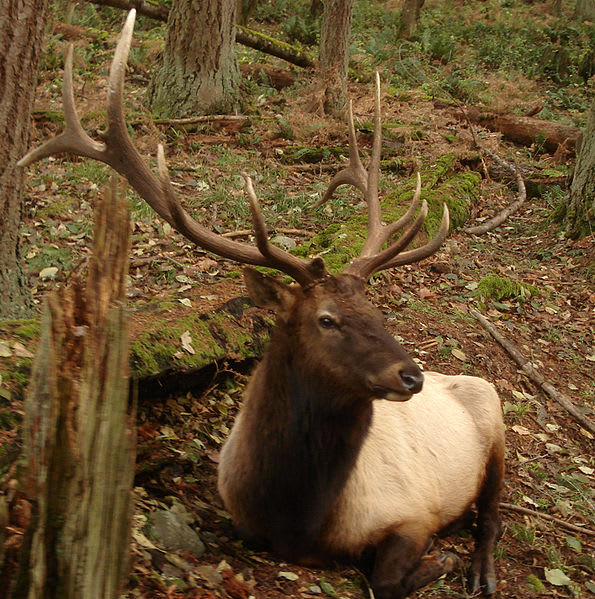
Overview
The largest North American elk. Compared with those of the Rocky Mountain elk, the antlers are much more rugged and massive, although generally shorter and with less spread. The fourth (royal) tine can be forked, and the ends of the antlers, which are often webbed or palmate, tend to form a crown or cup of three or more points. The body coloration has more contrast, with the back and sides turning pale fawn in winter, the head, legs and underparts a dark brown, and the neck almost black.
Taxonomy
- Kingdom
- Animalia
- Phylum
- Chordata
- Class
- Mammal
- Order
- Artiodactyla
- Family
- Cervidae
- Genus
- Cervus
- Species
- Cervus canadensis
Habitat
Dense evergreen rain forests, including mountain forests. Distribution- Canada: Except for a small herd in the Phillips Arm area, which probably migrated from Vancouver Island, and recently introduced herds near Sechelt and Powell River, the only Roosevelt Elk in British Columbia are the 3,000 to 3,500 members of the subspecies that live on Vancouver Island. United States: Coastal Washington and Oregon, west of Interstate 5; and northwestern California, essentially in Del Norte and Humboldt counties. Introduced (1927) on Afognak and Raspberry islands in the Gulf of Alaska. There was also a free-ranging herd on Santa Rosa Island off California's southern coast, which was introduced about 1910 from Washington's Olympic Peninsula but were exterminated by the United States Park Service along with the mule deer to return the island back to being void of wildlife before man arrived.
Diet
Roosevelt elk both graze and browse, consuming shrubs, ferns, lichens, and meadow grasses.
Behavior
Elk are highly adaptive herd animals that thrive in forest habitats. Elk will feed in both the morning and then hide out in dark timber to digest their food, conserve energy and remain cool during the heat of the day. During the summer months, elk will go high into mountains to take advantage of cooler temperatures. In the winter, they will migrate to lower elevations for shelter from bad weather and for more available food sources. The breeding season begins in early fall, when bulls will separate from each other and start seeking out suitable cows to join their harem. A harem is a bull’s group of suitable cows that he will travel and eventually mate with. Harems can eventually include up to 20 cows during a mating season. To attract cows, bulls will dig out watery marsh-like holes, lay in them and urinate in them. These stinky, murky mud baths are called wallows. The reason bull elk use wallows is to coat themselves with their own sexually pungent odor. By coating themselves in this manner, sexually willing cows can find them from a great distance with their noses. Once a bull has cows in his harem he is very protective of them and will fend off other bulls.
Hunting
The Roosevelt elk of the Pacific Northwest lives in some of the wettest, most difficult terrain in North America. Hunted mainly by locals who are familiar with the country and the animals, either on foot in the rain-soaked jungles, or from vehicles along the many logging tracks. In recent years, the best trophies have come from Vancouver Island in British Columbia; however, the Olympic Peninsula of Washington also holds some very large bulls, including a protected population in Olympic National Park that resupplies the surrounding area. Some years, many large park bulls are pushed out of the mountains into hunting areas by heavy snowfall. The introduced Afognak and Raspberry islands populations in Alaska live in conditions similar to those of the Pacific Northwest, but their antlers are smaller. Southern California's arid Santa Rosa Island is very different from the Roosevelt elk's natural habitat. Some unusual antler conformations were taken there, and the success rate was high. For record-keeping purposes, the Afognak and Raspberry island populations are treated as indigenous; those from Santa Rosa Island are listed separately.
Conservation Status
Elk as an entire species are listed as Least Concern by IUCN. Roosevelt elk are considered to have stable and sustainable populations.