
Overview
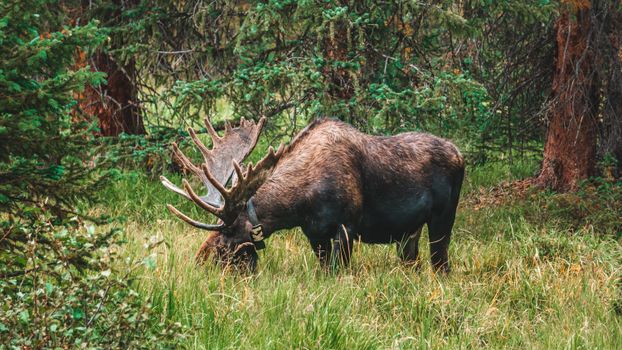
Alces alces, is the largest extant species in the deer family. Moose are distinguished by the broad, flat (or palmate) antlers of the males; other members of the family have antlers with a dendritic (twig-like) configuration. Their fur consist of two layers; top layer of long guard hairs and a soft wooly undercoat. The guard hairs are hollow and filled with air for better insulation, which also helps them stay afloat when swimming. Bull moose grow antlers like many others in the deer family. The male's antlers grow as cylindrical beams projecting on each side of the head at right angles to the midline of the skull, and then fork. The lower prong of this fork may be either simple, or divided into two or three tines, with some flattening. Moose antlers are broad and palmate (flat) with tines (points) along the outer edge.
Taxonomy
- Kingdom
- Animalia
- Phylum
- Chordata
- Class
- Mammal
- Order
- Artiodactyla
- Family
- Cervidae
- Genus
- Alces
Habitat
Moose typically inhabit boreal forests and temperate broadleaf and mixed forests of the Northern Hemisphere in temperate to subarctic climates.
Diet
A browser, depending on woody vegetation- notably willow, poplar, balsam, aspen and birch-eating leaves, twigs and bark. Feeds on aquatic vegetation by wading into lakes and streams, often submerging completely to feed on the bottom.
Behavior
Solitary except when mating, or a cow with her recent offspring, living by itself in a small home range. Not territorial. Mates in September and October, with bulls displaying and fighting for dominance and taking one female at a time. Bulls can be dangerous during the rut, and unarmed humans may be at risk. Calves are born in May and June, frequently twins, though often a single and occasionally triplets. Females can breed until about 18 years of age. Maximum longevity is 27 years. Vision is poor, with stationary objects seemingly not recognized at all. Senses of smell and hearing are excellent. Active throughout the day, but with peaks at dawn and dark. Silent except during the rut, when sexes call to each other with grunts and moans. Principal predator is the wolf, with grizzly in a lesser role. As a number of wolves are required to bring down a moose, healthy adults are not often attacked; calves and sick or aged adults are preferred prey.
Hunting
Hunting is done primarily by a combination of spot and stalk methods and calling during the right times of the year. The moose can be aggressive towards humans during the breeding season, so it is wise to stay armed.
Conservation Status
Listed as Least Concern by IUCN.