
Overview
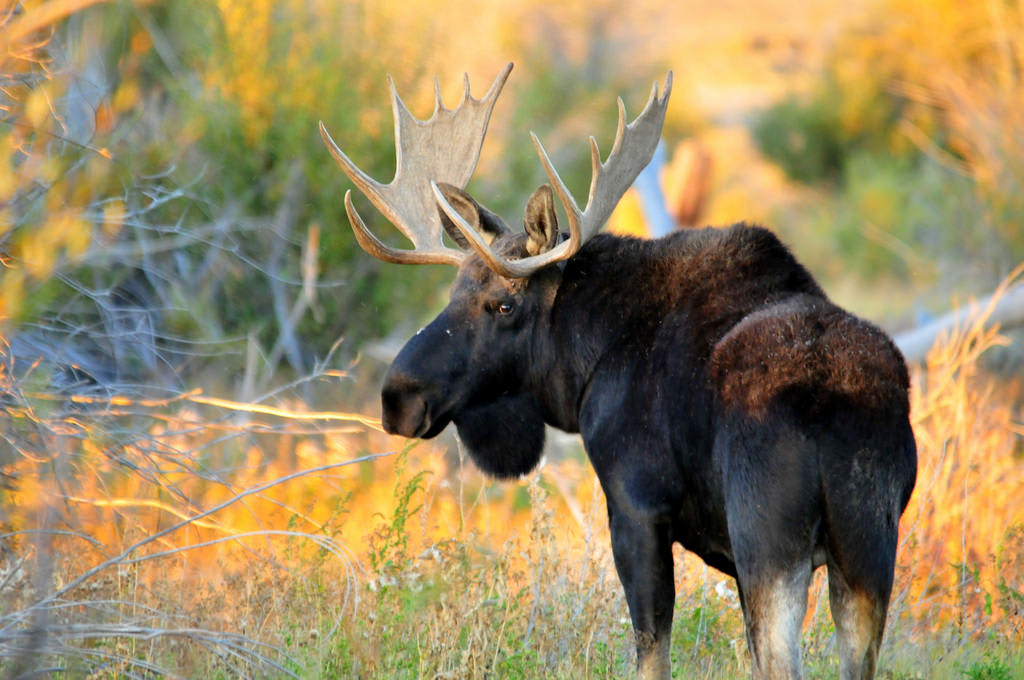
The Shiras moose has the smallest antlers and body size of any North American moose. The body color is a rusty yellowish-brown, with a pale brownish saddle.
Taxonomy
- Kingdom
- Animalia
- Phylum
- Chordata
- Class
- Mammal
- Order
- Artiodactyla
- Family
- Cervidae
- Genus
- Alces
- Species
- Alces alces
Habitat
Mountains and foothills with suitable browse, typically do not frequent thick cover and aquatic regions as much as other moose. Distribution- Canada: Southwestern British Columbia, commencing at the International Boundary at Sumas Highway 11 to Trans-Canada Highway#1 following southeastern along the Trans-Canada Highway #1; and Southwestern Alberta south of the Trans-Canada Highway #1 and west of Highway #2 to the International Boundary. United States: Northeastern Washington, northern and eastern Idaho, western Montana, western and southern Wyoming, northeastern Utah, and northwestern Colorado.
Diet
Diet consists of alder branches, grass and shrubs. These moose do not frequent swamps and water as the other subspecies do.
Behavior
Solitary except when mating, or a cow with her recent offspring, living by itself in a small home range. Not territorial. Mates in September and October, with bulls displaying and fighting for dominance and taking one female at a time. Bulls can be dangerous during the rut, and unarmed humans may be at risk. Calves are born in May and June, frequently twins, though often a single and occasionally triplets. Females can breed until about 18 years of age. Maximum longevity is 27 years. Vision is poor, with stationary objects seemingly not recognized at all. Senses of smell and hearing are excellent. Active throughout the day, but with peaks at dawn and dark. Silent except during the rut, when sexes call to each other with grunts and moans. Principal predator is the wolf, with grizzly in a lesser role. As a number of wolves are required to bring down a moose, healthy adults are not often attacked; calves and sick or aged adults are preferred prey.
Hunting
Hunting is done primarily by a combination of spot and stalk methods and calling during the right times of the year. The moose can be aggressive towards humans during the breeding season, so it is wise to stay armed. At this time, non-residents are allowed to hunt Shiras moose in British Columbia and Alberta, and may hunt by drawn permit in Washington, Idaho, Montana, Wyoming, Utah and Colorado. Best odds for drawing are in Utah, with Wyoming next.
Conservation Status
Listed as Least Concern by IUCN.