
Overview
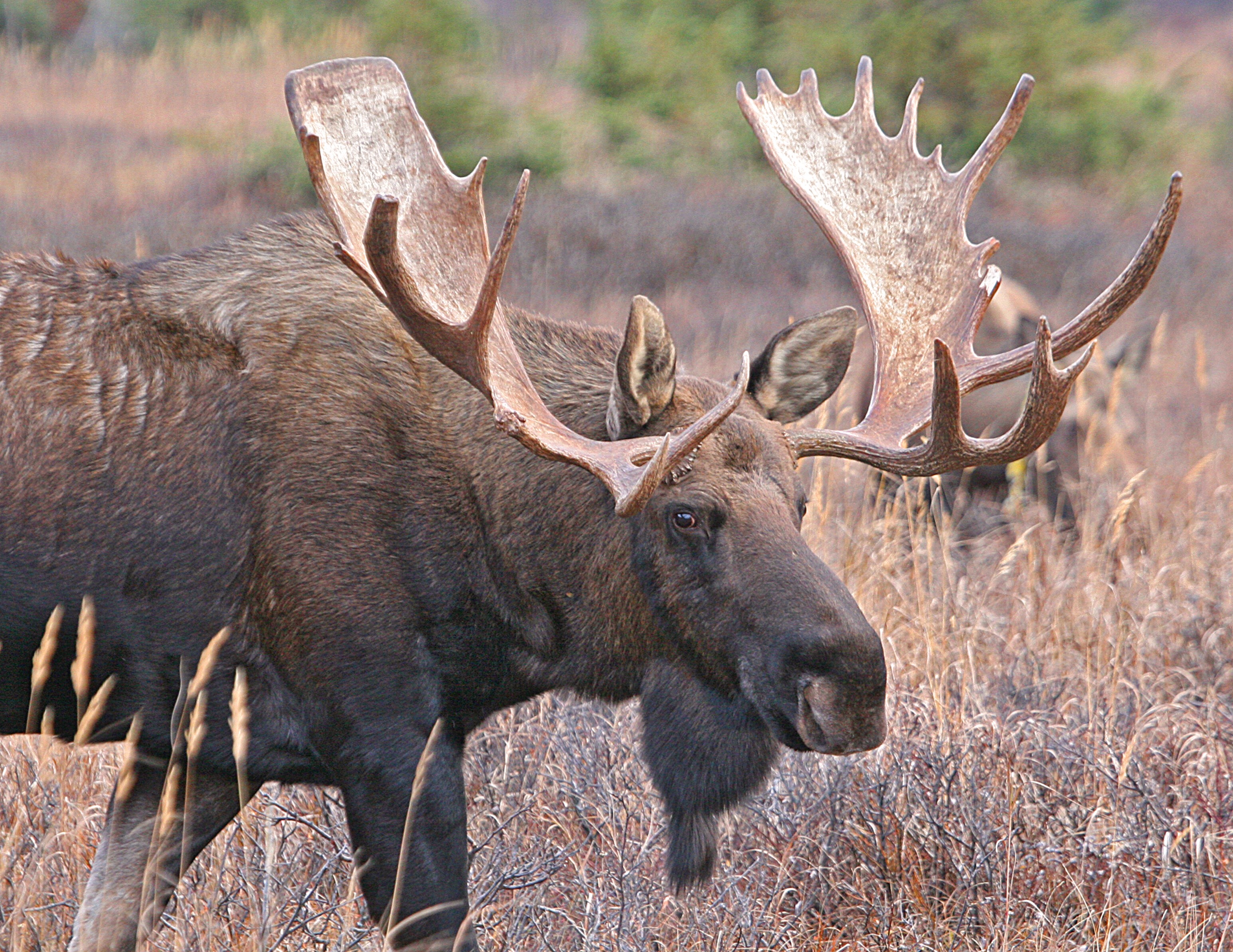
The largest of all moose, and have been estimated to weigh as much as 1,800 lbs (815 kg), although it is doubtful if many exceed 1,400 lbs (635 kg). (Understandably, few wild moose are ever weighed whole.) The heaviest weights actually recorded for Alaska moose in one piece are 1,310 lbs (595 kg) for a male and 1,080 lbs (490 kg) for a female. The overall coloration is blackish, with a rusty brown saddle area. Vision is poor, with stationary objects seemingly not recognized at all. Senses of smell and hearing are excellent. Active throughout the day, but with peaks at dawn and dark. Despite it ungainly appearance, the moose is nimble and surefooted. Able to cross swamps and quicksand where other animals would mire. Its normal gait is is a quiet, careful walk, but can maintain a speed of 35 mph (56 km/h) for a considerable distance. Has great endurance, able to run up mountainsides or through deep snow or downed timber for miles. An excellent swimmer.
Taxonomy
- Kingdom
- Animalia
- Phylum
- Chordata
- Class
- Mammal
- Order
- Artiodactyla
- Family
- Cervidae
- Genus
- Alces
- Species
- Alces alces
Habitat
This moose is found in a range of woodland habitats, both coniferous and broadleaved, from the tundra and taiga down to more southern boreal and temperate regions. This subspecies prefers a mixture of second-growth boreal forest, clearings, swamps, lakes and wetlands. Distribution- Alaska, Yukon, and the Mackenzie Mountains in the far west of the Northwest Territories.
Diet
A browser, depending on woody vegetation- notably willow, poplar, balsam, aspen and birch-eating leaves, twigs and bark. Feeds on aquatic vegetation by wading into lakes and streams, often submerging completely to feed on the bottom.
Behavior
Solitary except when mating, or a cow with her recent offspring, living by itself in a small home range. Not territorial. Mates in September and October, with bulls displaying and fighting for dominance and taking one female at a time. Bulls can be dangerous during the rut, and unarmed humans may be at risk. Calves are born in May and June, frequently twins, though often a single and occasionally triplets. Females can breed until about 18 years of age. Maximum longevity is 27 years. Vision is poor, with stationary objects seemingly not recognized at all. Senses of smell and hearing are excellent. Active throughout the day, but with peaks at dawn and dark. Silent except during the rut, when sexes call to each other with grunts and moans. Principal predator is the wolf, with grizzly in a lesser role. As a number of wolves are required to bring down a moose, healthy adults are not often attacked; calves and sick or aged adults are preferred prey.
Hunting
Hunting is done primarily by a combination of spot and stalk methods and calling during the right times of the year. The moose can be aggressive towards humans during the breeding season, so it is wise to stay armed.
Conservation Status
Listed as Least Concern by IUCN.