
Overview
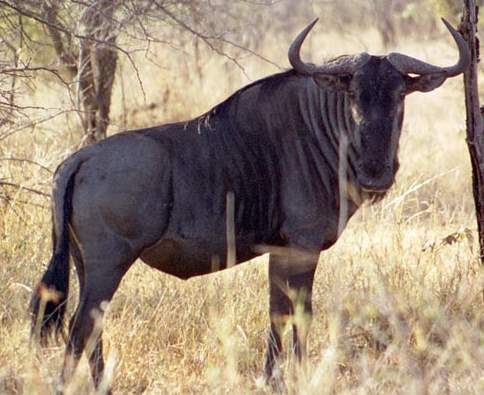
Nearly everyone calls it blue wildebeest, though it is not actually blue (but in some lights its color could be interpreted as bluish gray). The general color is dark silvery gray with a brown tinge. The beard is black. This broad-shouldered antelope has a muscular, front-heavy appearance, with a distinctive robust muzzle. Young blue wildebeest are born tawny brown, and begin to take on their adult colouration at the age of two months. The adults' hues range from a deep slate or bluish gray to light gray or even grayish-brown. Both sexes possess a pair of large curved horns.
Taxonomy
- Kingdom
- Animalia
- Phylum
- Chordata
- Class
- Mammal
- Order
- Artiodactyla
- Family
- Bovidae
- Genus
- Connochaetes
- Species
- Connochaetes taurinus
Habitat
Blue wildebeest are found in short grass plains bordering bush-covered acacia savannas in southern and eastern Africa, thriving in areas that are neither too wet nor too arid. Each year, some East African populations of blue wildebeest take part in a long-distance migration, seemingly timed to coincide with local patterns of rainfall and grass growth. Distribution- Southern Angola, western Zambia, northern and eastern Namibia, most of Botswana, western and southern Zimbabwe, and parts of Mozambique south of the Zambezi. Formerly widespread in South Africa north of the Orange and Vaal Rivers; however, they were shot out by early European settlers except for relic populations in northwestern Cape Province and northern and eastern Transvaal, and game reserves in northern Natal. But today they are widely re-established on private ranches in all parts of South Africa, so the extent of their distribution (though not their absolute numbers) probably exceeds what existed before Europeans arrived.
Diet
Feeds primarily on short grasses.
Behavior
It forms herds which move about in loose aggregations, the animals being fast runners and extremely wary. The mating season begins at the end of the rainy season and a single calf is usually born. The calf remains with its mother for eight months, after which time it joins a juvenile herd.
Hunting
As they live on open plains, blue wildebeests are not hard to locate, but approaching them and determining sex and horn size may be difficult, especially in areas where they are regularly hunted. Often there is little cover, and long shots may be required.
Conservation Status
Listed as Least Concern by IUCN as an overall species, however the Eastern White-bearded Wildebeest subspecies is considered to be in serious decline.