
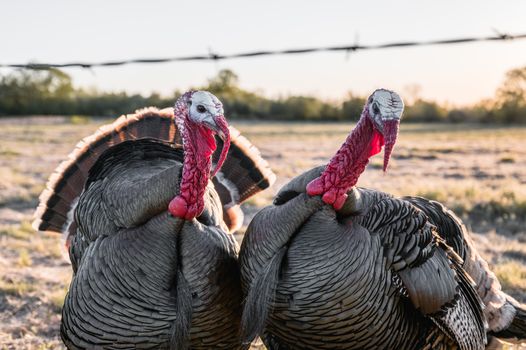
Overview
Large ground bird native to North America, premier game species.
Taxonomy
- Class
- Aves
Habitat
Wild turkeys primarily inhabit deciduous and mixed forests, open woodlands, and areas with agricultural fields for foraging. They are native to North America, ranging from the eastern United States to parts of Mexico, and have been introduced to the western U.S. and other regions. They prefer terrains that offer a mix of cover for roosting and open spaces for feeding.
Diet
Wild turkeys are omnivorous, feeding on acorns, nuts, seeds, berries, insects, and occasionally small reptiles or amphibians. They forage on the ground by scratching through leaf litter, primarily during early morning and late afternoon. Their diet varies seasonally, with more plant matter in fall and winter, and insects in spring and summer.
Behavior
Wild turkeys are social birds that form flocks, especially outside the breeding season, with hens and their young grouping together. They are diurnal, spending days foraging and moving in groups, while roosting in trees at night to evade predators. Males exhibit territorial behavior during breeding, using loud gobbling calls to attract females and challenge rivals, and they can run at speeds up to 25 mph when threatened.
Hunting
Hunting wild turkeys requires stealth and skill, primarily using 12- or 20-gauge shotguns with #4 to #6 shot for effective close-range patterning, or compound bows with fixed broadheads for archery challenges; key methods include calling with box, slate, or mouth calls to mimic hens and lure gobblers, often paired with decoys in fields or forested areas for spot-and-stalk or ambush setups. The best seasons are spring for gobbler hunts during breeding periods and fall for mixed-bag opportunities, with timing varying by region—typically March to May in the spring and October to December in the fall—so always consult state regulations for exact dates and bag limits. Trophy criteria focus on mature toms with long spurs (over 1.25 inches), beard length (preferably over 10 inches), and overall weight, with records tracked by the National Wild Turkey Federation for outstanding specimens. Legal hunting is available across the United States in states like Texas, Pennsylvania, New York, and Georgia, as well as parts of Canada such as Ontario and British Columbia, through regulated seasons managed by state wildlife agencies; in some areas, private lands offer guided hunts. Regulated hunting has been a cornerstone of wild turkey conservation, with license fees and excise taxes funding habitat restoration and population monitoring under the North American Model, which has restored turkey numbers from near extinction in the early 1900s to over 7 million today, proving the effectiveness of hunter-supported wildlife management programs.
Conservation Status
The wild turkey is listed as Least Concern by the IUCN, with populations stable or increasing due to successful conservation and reintroduction efforts. Major threats include habitat loss from urbanization and overhunting, though regulated hunting has helped maintain healthy numbers.