
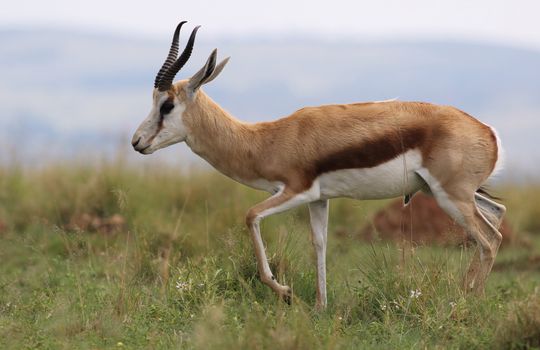
Taxonomy
- Kingdom
- Animalia
- Phylum
- Chordata
- Class
- Mammal
- Order
- Artiodactyla
- Family
- Bovidae
- Genus
- Antidorcas
Habitat
Springboks primarily inhabit arid and semi-arid savannas, grasslands, and open plains in southern Africa, including regions of Namibia, Botswana, and South Africa. They prefer areas with short grasses and scattered shrubs, adapting well to dry environments with minimal water sources. These habitats allow them to evade predators through speed and open visibility.
Diet
Springboks are herbivores that primarily graze on grasses and browse on leaves, shrubs, and forbs. They feed mainly in the early morning and late afternoon to avoid the midday heat, consuming a variety of plants to meet their water needs in arid environments. Their feeding behavior includes selective grazing to maximize nutrient intake.
Behavior
Springboks are highly social, forming herds of up to several hundred individuals, often led by a dominant male who defends the group. They are diurnal, active during the day, and exhibit pronking—a stiff-legged jumping behavior—to confuse predators and signal danger. Territorial males mark and defend their areas, while females and young stay in loose groups for protection.
Hunting
Springbok are a premier antelope species for hunters in southern Africa, offering exciting spot-and-stalk opportunities in open grasslands and savannas where their speed and pronking behavior make for challenging pursuits; use binoculars for glassing from a distance and approach with the wind in your favor for the best results. Opt for a lightweight rifle in calibers like .243 Winchester, .270 Winchester, or 6.5 Creedmoor for precise shots at medium ranges, paired with premium expanding bullets to ensure ethical, one-shot kills on their vital areas, such as the heart-lung zone behind the shoulder. The best hunting seasons are during the dry months from May to October in countries like Namibia, South Africa, and Botswana, when animals concentrate around water sources and visibility is optimal for tracking; many hunts occur on private game ranches that manage populations sustainably. Trophy springbok are judged by the length and symmetry of their lyre-shaped horns, with top entries in Safari Club International (SCI) records exceeding 14 inches; aim for mature rams with horns over 12 inches for a quality trophy. Legal springbok hunting in these regions funds essential conservation efforts, such as anti-poaching patrols and habitat restoration through conservancy fees, demonstrating how regulated harvests under systems like those in Namibia have maintained stable populations and supported the overall Least Concern status of the species.
Conservation Status
The IUCN status of springboks is Least Concern, with a stable population trend due to their wide distribution. Major threats include habitat fragmentation from agriculture and occasional overhunting.