
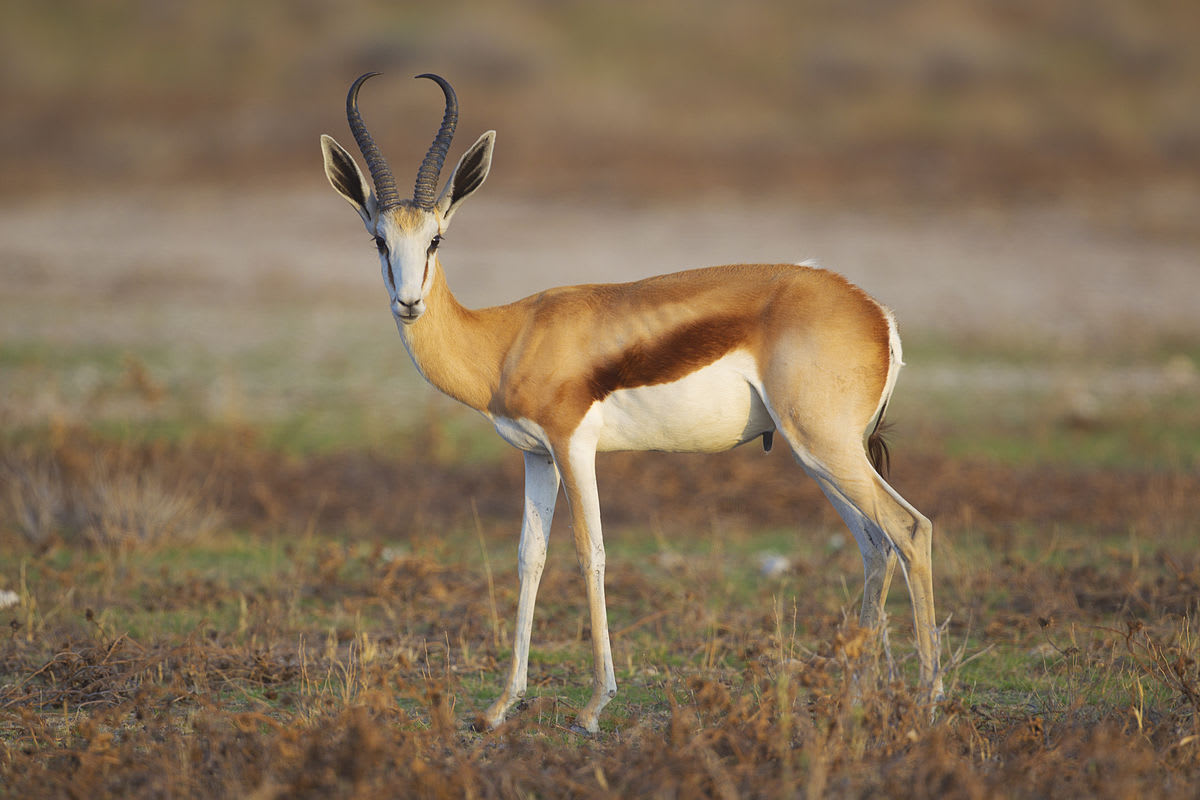
Overview
Up to 25 percent smaller than other springboks and has shorter horns, but is otherwise similar. Has distinct coloration differences from the Kalahari springbok on the face, body and rump.
Taxonomy
- Kingdom
- Animalia
- Phylum
- Chordata
- Class
- Mammal
- Order
- Artiodactyla
- Family
- Bovidae
- Genus
- Antidorcas
- Species
- Antidorcas marsupialis
Habitat
Grasslands, bushlands, and shrublands. Distribution- South Africa, south of the Orange River.
Diet
These animals both graze and browse based on seasonal availability. They can sometimes go their entire lives without drinking water, as they derive moisture from food and selectively feed in the morning when plants contain the most moisture.
Behavior
A feature unique to the springbok is pronking, in which the springbok performs multiple leaps into the air, up to 6.6 ft (2 m) above the ground, in a stiff-legged posture, with the back bowed and the white flap lifted. When the male shows off his strength to attract a mate, or to ward off predators, he starts off in a stiff-legged trot, leaping into the air with an arched back every few paces and lifting the flap along his back. Lifting the flap causes the long white hairs under the tail to stand up in a conspicuous fan shape, which in turn emits a strong scent of sweat. Although the exact cause of this behaviour is unknown, springbok exhibit this activity when they are nervous or otherwise excited. The most accepted theory for pronking is that it is a method to raise alarm against a potential predator or confuse it, or to get a better view of a concealed predator; it may also be used for display.
Hunting
Spot and stalk methods or hunting over a water source.
Conservation Status
Listed as Least Concern by IUCN.