
Overview
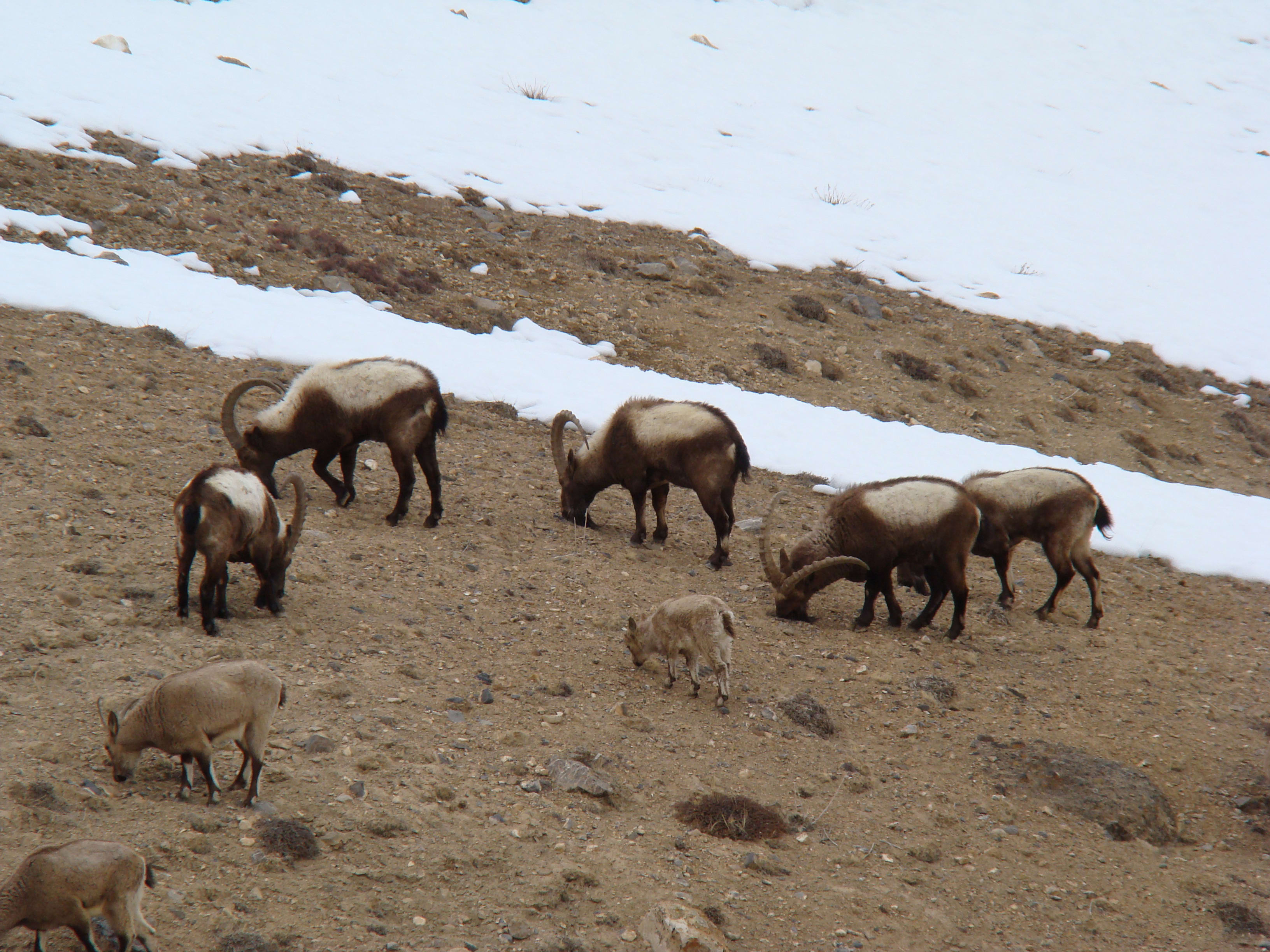
A large ibex, thick-legged and stoutly built, with a long, pointed chin beard and heavy, scimitar-shaped horns. The summer coat is short, becoming long, coarse and brittle in winter with a dorsal crest and thick undercoat. Color is variable, but generally in summer it is some shade of yellowish or grayish-brown with a darker dorsal stripe, dark underparts and legs, and without a lighter saddle patch. Winter coat is yellowish-white and usually there is a large, light saddle patch. The dorsal stripe, tail and beard are blackish-brown. The male's horns are large and impressive, curving around to form three-fourths of a circle and tapering to relatively slender points. Horns are relatively flat on the front surface and have well-defined cross ridges. Females grow short, thin horns and lack beards.
Taxonomy
- Kingdom
- Animalia
- Phylum
- Chordata
- Class
- Mammal
- Order
- Artiodactyla
- Family
- Bovidae
- Genus
- Capra
- Species
- Capra sibirica
Habitat
Open, precipitous terrain at any altitude. Distribution- Sayan and Altai mountains of Siberia and Mongolia. Outside Asia, it has been introduced in the wild in New Mexico. Also found on private ranches in several parts of the world.
Diet
Alpine grasses and herbs. Distribution- China, Kazakhstan, Mongolia, Russia, Asia
Behavior
Gregarious, living in herds of 40-50, sometimes more. Older males are often solitary or in small groups of 3-4, frequently in more inaccessible terrain. A grazer. Eyesight and sense of smell are excellent.
Hunting
Hunting methods will vary based on topography of the specific area, but generally ibex are pursued through spot and stalk methods, glassing from vantage points and then pursuing a herd containing a desired male. Hunters should be in good physical condition and be prepared for precipitous terrain and potentially long shots.
Conservation Status
Listed as Least Concern by IUCN.