
Overview
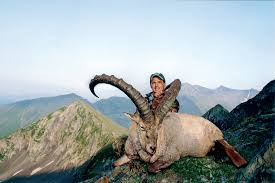
This animal is not a sheep but a goat. This animal is a true naturally-occurring cross between the Dagestan (Eastern) and Kuban (Western) tur. The horns of some animals tend to look almost exactly like either the Eastern or Western tur, while most exhibit horn characteristics of both. Compared to the true west Caucasian tur (subspecies dinniki), the severtzovi race to the east (but still west of Mt. Elbrus) is described as slightly taller and the black horns being somewhat smoother, with smaller cross ridges, and the tips may be closer together. The beard is shorter, being only of moderate length. Summer coat is reddish-gray, with forehead and chest darker and browner; front of legs darker, becoming black near the hoofs; belly and inner thighs a dirty white. A darker dorsal stripe may or may not be present. The caucasica race from Mt. Elbrus eastward to Mt. Dykhtau was originally described as a hybrid between severtzovi and the east Caucasian tur (cylindricornis). This is confirmed by recent observers who describe a wide variety of hybrids from this area, often in large herds that include a number of different forms. Individual horns are said to vary from supracervical like those of cylindricornis, though often with cross ridges like those of dinniki, to long and scimitar-shaped like those of dinniki, but relatively smooth like those of cylindricornis. The caucasica race is generally darker in color than the severtzovi race, and with a dark dorsal streak. The winter coat is dark brown.
Taxonomy
- Kingdom
- Animalia
- Phylum
- Chordata
- Class
- Mammal
- Order
- Artiodactyla
- Family
- Bovidae
- Genus
- Capra
- Species
- caucasica
Habitat
Usually found in open, precipitous terrain at higher elevations, but may also be found lower down in thick forest. Descends to lower elevations in winter to escape heavy snow. Distribution- West-central Caucasus Mountains (except for the range of the west Caucasian tur in the far northwest). Includes severtzovi (western Caucasus, east of the range of the Kuban tur and west of Mt. Elbrus) and caucasica (central Caucasus, from Mt. Elbrus east to Mt. Dykhtau). Boundaries with the west Caucasian tur are unclear. Described another way as considered to be found east of Mt. El’brus and west of the Republic of North Osetiya, solely within the Republic of Kabardino-Balkariya.
Diet
Prefers to feed on forbs and grasses, but will browse when necessary. Obtains water from small pools high in the mountains.
Behavior
Gregarious, sometimes in large herds numbering several hundred. Males and females keep separate except during mating season.
Hunting
This is a very fine and sporting game animal, hunted in steep, high mountains where good physical condition on the part of the hunter is a must. Weather in this region is much better than in the western Caucasus.The horns resemble the blue sheep enough to have interested sheep hunters for a long time. The Ovis World Slam includes this tur.
Conservation Status
Listed as Endangered by the IUCN in comparison to the Near Threatened listing of the East Caucasian Tur.