
Overview
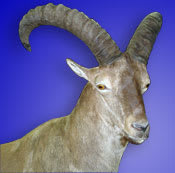
Larger than the Mid-Caucasian tur. This goat's face is short and blunt. The hooves are large. The beard is long (up to seven inches, or 178 mm), narrow and prominent. The short summer coat is yellowish-tan, lighter on the back and sides, darker on the head, very dark brown on the tail and lower legs, and dirty white on the belly. The winter coat is heavier and coarser, varying from grayish to yellowish-brown, with a dark dorsal stripe. The horns are black and rather similar to those of an ibex, being scimitar-shaped and having prominent cross ridges on the front surface, but they are much more massive and relatively shorter. The tips are widely separated, the distance varying from about 16-26 inches (41-66 cm), sometimes more. The horns appear almost circular in cross section, actually being triangular with strongly rounded angles and bulging surfaces (especially the orbital and nuchal surfaces; the front surface is flatter). Females have thin, weak horns that are elliptical in section and slightly curved.
Taxonomy
- Kingdom
- Animalia
- Phylum
- Chordata
- Class
- Mammal
- Order
- Artiodactyla
- Family
- Bovidae
- Genus
- Capra
- Species
- Capra caucasica
Habitat
Open, precipitous terrain at higher elevations, normally above the timber line. Descends to lower elevations in winter to escape heavy snow. Distribution- A limited range at the extreme northwestern end of the Caucasus Mountains, from Mt. Cugus (northeast of Krasnaya Polyana, which is northeast of Sochi) eastward to include the upper reaches of the Belaya and Laba rivers. Boundaries with the mid-Caucasian tur are unclear.
Diet
Prefers to feed on forbs and grasses, but will browse when necessary. Obtains water from small pools high in the mountains.
Behavior
Gregarious, sometimes in large herds numbering several hundred. Males and females remain separate except during the mating season.
Hunting
The hunt is physically demanding and long shots may be required. Bad weather can be a problem in this region, and hunters should be in good physical condition to pursue this animal. Caucasian chamois, mideastern brown bear, mideastern red deer and the occasional wolf may also be seen, but bear and red deer are not open on early hunts.
Conservation Status
Listed as Endangered by IUCN.