
Overview
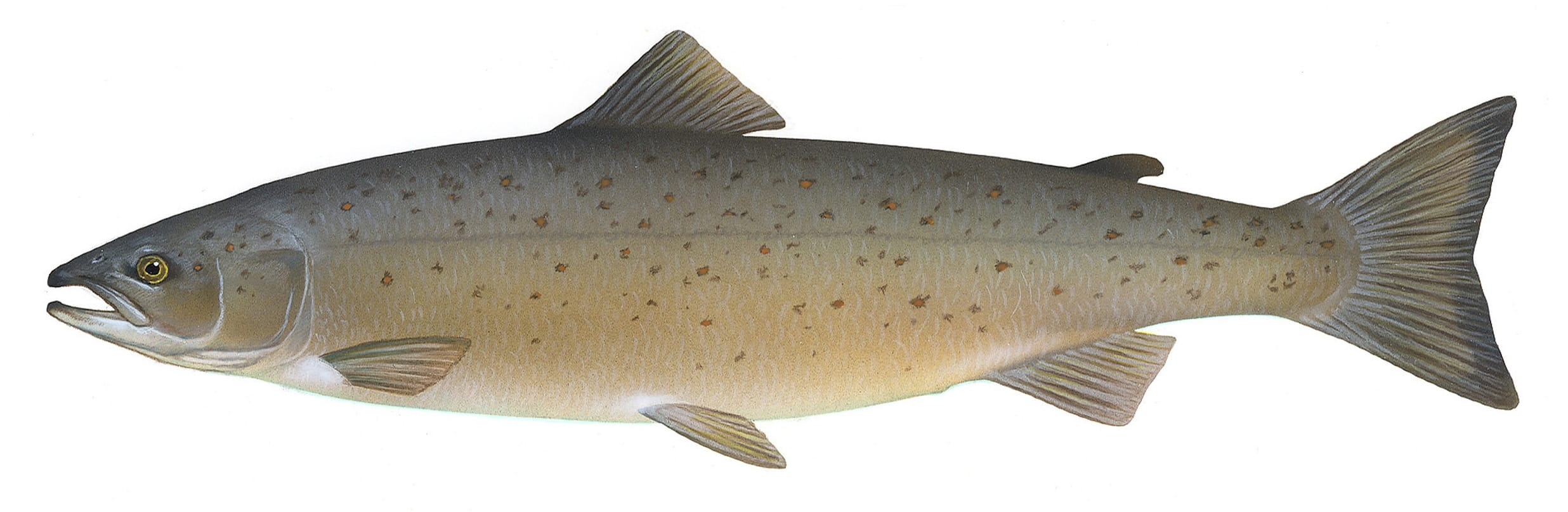
It has the body shape of a trout, and is distinguished from trouts of the genus Oncorhynthus by coloration, size, and location of occurrence, among other things. At sea it is a silvery fish with a sparse scattering of small black spots often shaped like X's or Y's on the upper half of the body, and sometimes with a few spots on the cheek and gill cover. In inland waters, especially at spawning time, the Atlantic salmon turns a much darker color of bronze or dark brown. This change may be accompanied by the appearance of red spots on the head and body, making this fish look remarkably like a brown trout (Salmo trutta), its closest relative. Often brown trout may have circles, or halos, around some of its spots and the spotting may be heavier than in the Atlantic salmon, extending onto the lower half of the sides and the fins including the adipose fin. The spots do not normally take the form of X's or Y's.
Taxonomy
- Kingdom
- Animalia
- Phylum
- Chordata
- Class
- Actinopterygii
- Order
- Perciformes
- Family
- Salmonidae
- Genus
- Salmo
- Species
- salar
Habitat
Streams, Rivers, Oceans
Diet
Insects, Small fish, Plankton
Behavior
The Atlantic salmon spawn in small rivers or streams, then make their way back to the ocean or river.
Fishing
The value of the Atlantic Salmon both as a sports fish and as a commercial and food fish cannot be exaggerated.
Conservation Status
Listed as Least Concern by IUCN.