
Overview
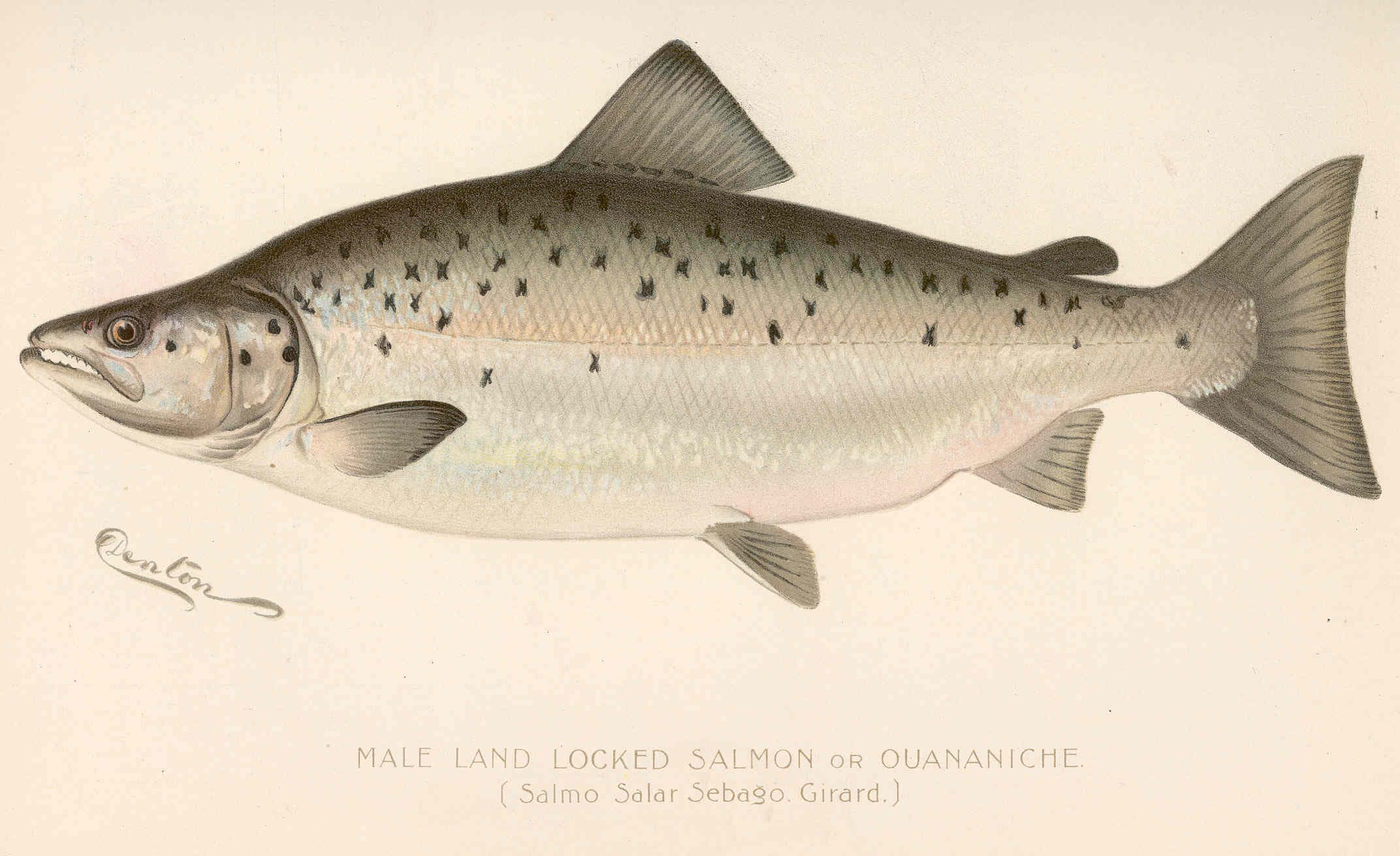
It has the body shape of a trout, and is distinguished from trouts of the genus Oncorhynthus by coloration, size, and location of occurrence, among other things. At sea it is a silvery fish with a sparse scattering of small black spots often shaped like X's or Y's on the upper half of the body, and sometimes with a few spots on the cheek and gill cover. In inland waters, especially at spawning time, the Atlantic salmon turns a much darker color of bronze or dark brown. This change may be accompanied by the appearance of red spots on the head and body, making this fish look remarkably like a brown trout (Salmo trutta), its closest relative. Often brown trout may have circles, or halos, around some of its spots and the spotting may be heavier than in the Atlantic salmon, extending onto the lower half of the sides and the fins including the adipose fin. The spots do not normally take the form of X's or Y's.
Taxonomy
- Kingdom
- Animalia
- Phylum
- Chordata
- Class
- Actinopterygii
- Order
- Perciformes
- Family
- Salmonidae
- Genus
- Salmo
- Species
- salar sebago
Habitat
The Atlantic Salmon is native to the northern Atlantic from the Connecticut River to Quebec, Iceland and southern Greenland. The species is anadromous (migrates to the sea and back, and spawns in fresh water). Unlike Pacific salmons (Oncorhynchus spp.), Atlantic salmon spawn more than once before dying.
Diet
Landlocked Atlantic salmon primarily feed on smaller fish such as smelt, alewives, and minnows, as well as insects and crustaceans in their freshwater habitats. They are opportunistic predators that hunt actively in schools or individually, especially during dawn and dusk when visibility is lower. Feeding intensity increases in cooler water temperatures to support their high energy needs.
Behavior
Landlocked Atlantic salmon are generally solitary but may form loose schools in open water for feeding. They are highly active swimmers in cold, deep waters, often migrating within lakes or rivers to find food or spawning sites, and exhibit aggressive territorial behavior during spawning seasons. These fish are known for their impressive leaping ability when navigating obstacles, making them challenging for anglers.
Fishing
The value of the Atlantic salmon both as a sports fish and as a commercial and food fish cannot be exaggerated.
Conservation Status
Listed as Least Concern by IUCN.