
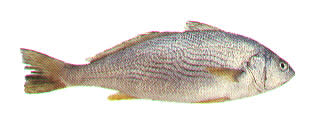
Taxonomy
- Kingdom
- Animalia
- Phylum
- Chordata
- Class
- Actinopterygii
- Order
- Perciformes
- Family
- Sciaenidae
- Genus
- Umbrina
- Species
- roncador
Habitat
They prefer bays, channels, and harbors rather than sandy bottoms.
Diet
Yellowfin croakers primarily feed on small crustaceans, polychaete worms, and mollusks found on the ocean floor. They are nocturnal bottom feeders, using their barbel to detect and consume prey in sandy or muddy substrates. Feeding activity peaks at night in shallow waters.
Behavior
Yellowfin croakers are schooling fish that form loose groups for protection while foraging. They are primarily nocturnal, spending days resting on the bottom and becoming active at night to feed and avoid predators. They produce grunting sounds using their swim bladder for communication, especially during spawning seasons. These fish are adaptable and often migrate in response to water temperature changes.
Fishing
Anglers targeting yellowfin croaker will find bottom fishing techniques highly effective, using a simple rig to present bait on the ocean floor where these schooling fish feed nocturnally on crustaceans and mollusks. Opt for medium-light tackle, such as a 7-9 foot rod with 10-20 pound test line and a size 2-4 hook on a Carolina rig, paired with live bait like shrimp, worms, or small crabs for the best results, as these mimic their natural prey. The prime season is late spring through early fall, with peak activity at night in warmer months when they are most active in shallow waters. Focus on bays, channels, and harbors along the Eastern Central Pacific, from Point Conception to the Gulf of California, targeting sandy or muddy substrates for consistent catches. Yellowfin croaker can reach up to 5 pounds 8 ounces, with the IGFA all-tackle world record at that weight, caught in California. These fish are managed under effective regulations like seasonal closures and size limits, which are proven tools for maintaining stable populations—supported by angler-funded programs that bolster conservation through habitat restoration and stocking initiatives in these critical coastal waterways.
Conservation Status
Listed as Least Concern by IUCN.