
Overview
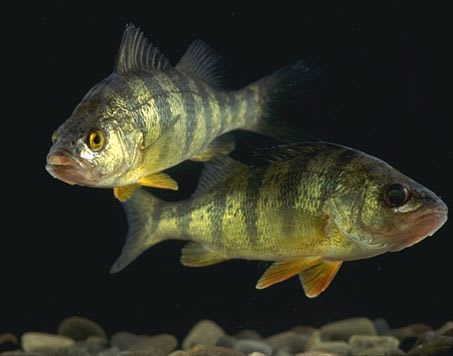
The yellow perch, unlike the so called white perch, Morone americana, is a true perch, not a bass. Its most striking characteristic is its golden yellow body with 6 8 dark “fingers” or bands which extend from the back towards the belly.
Taxonomy
- Kingdom
- Animalia
- Phylum
- Chordata
- Class
- Actinopterygii
- Order
- Perciformes
- Family
- Percidae
- Genus
- Perca
- Species
- flavescens
Habitat
They are commonly found in the littoral zones of both large and small lakes, but they also inhabit slow-moving rivers and streams, brackish waters, and ponds. Yellow perch commonly reside in shallow water, but are occasionally found deeper than 15 m or on the bottom.
Diet
Large adult perch feed on invertebrates, fish eggs, crayfish, mysid shrimp, and juvenile fish.
Behavior
Perch are commonly active during the day and inactive at night except during spawning, when they are active both day and night. Perch are most often found in schools. Their vision is necessary for schooling and the schools break up at dusk and reform at dawn. The schools typically contain 50 to 200 fish, and are arranged by age and size in a spindle shape.
Fishing
It will devour almost any natural bait and many types of artificials, including flies, and is an active feeder even in the winter when it is caught while ice fishing. It is one ofthe most abundant and well-known pan-fish in the northeastern United States. The flesh is white, flaky and delicious.
Conservation Status
Listed as Least Concern by IUCN.