
Overview
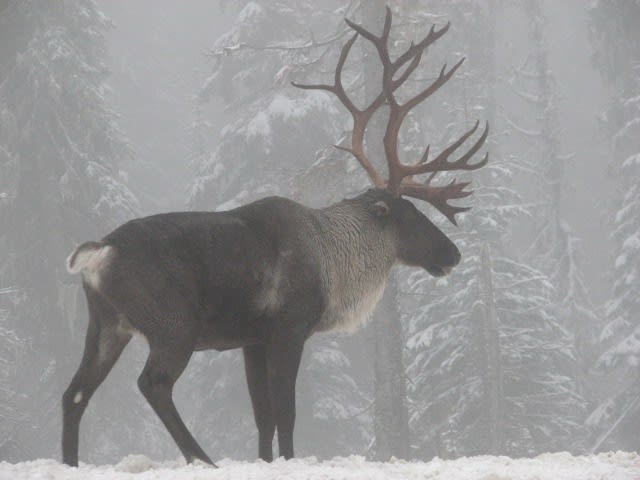
This is the largest bodied caribou. The color is a fairly dark chocolate-brown, with a lighter-colored throat mane that turns almost white in late season. Mountain caribou grow the heaviest antlers of the species, but tend not to have very wide spreads.
Taxonomy
- Kingdom
- Animalia
- Phylum
- Chordata
- Class
- Mammal
- Order
- Artiodactyla
- Family
- Cervidae
- Genus
- Rangifer
- Species
- Rangifer tarandus
Habitat
Mid-elevation mountains and valleys. Distribution- Yukon Territory: South of Game Management Zone 2 (1978 regulations), and further identified as south of the Stewart River and-from the junction of the Stewart and Yukon rivers-south of the Yukon River. Northwest Territories: South of latitude 66°N and west of the Mackenzie River to Great Slave Lake, then south of Great Slave Lake to the Slave River. British Columbia and Alberta: All parts where caribou are found, except for the northeastern corner of Alberta east of the Slave River. United States: The endangered Selkirk Herd extends marginally into northeastern Washington and northern Idaho.
Diet
These animals browse and also consume lichens and mosses.
Behavior
Mountain caribou herds are not nearly as large as those of barren ground caribou, nor are their seasonal migrations as long, often being mainly changes in elevation. Mountain caribou go high in the mountains during the summer to avoid biting insects, thenmove into lower valleys as the winter arrives. Named herds include the Selkirk, Spatsizi, and Wells Gray.
Hunting
Many sportsmen feel that mountain caribou have the most impressive antlers because of their mass, even though they lack the beam length of the barren ground types and the spread and shovels of the Quebec-Labrador. They may also be the most difficult to hunt because of the mountainous, timbered terrain they inhabit. Usually hunted from horseback, often in combination with other species such as moose, mountain goat or sheep.
Conservation Status
Caribou as an overall species are listed as Least Concern by IUCN. Much of the boreal forest these caribou prefer has been damaged or is threatened. The caribou of the Selkirk Herd of southeastern British Columbia (bounded by the Canada-U.S. border, Columbia River, Kootenay River, Kootenay Lake and Kooentai River), northeastern Washington and northern Idaho are listed as endangered by the USF&WS (1983).