
Overview
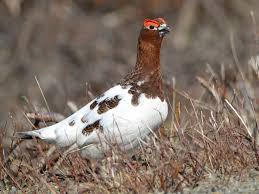
The largest of the three Ptarmigan species. The thick, wide bill is a trademark of all willow ptarmigan, the largest of our three ptarmigan species. Another distinction is the white patch behind the male’s bill, lasting only two or three weeks in spring, before the chestnut plumage of early summer comes in. Only another ptarmigan can distinguish cocks from hens when willow ptarmigan are in winter plumage. Then, both sexes are white with black tail feathers. Beginning early in May the cocks develop a beautiful cape of chestnut-red feathers. They court the hens in this plumage, not completing the change to the brown summer plumage until the hens are nearly finished incubating the clutch of eggs. No sooner does the male get this first set of dark chestnut feathers, however, than a new generation of lighter brown feathers grows on its neck and breast. This new set is never completed, because by early August the cock is beginning to grow white feathers for the coming winter plumage. In mid-August male ptarmigan are a patchwork of four sets of feathers; a few old winter feathers on the wings, new white feathers on toes and belly, and parts of the light spring and darker summer feathers.
Taxonomy
- Kingdom
- Animalia
- Phylum
- Chordata
- Class
- Bird
- Family
- Phasianidae
- Genus
- Lagopus
- Species
- lagopus
Habitat
Its typical habitat is upland heather moors away from trees. It can also be found in some low-lying bogs and birds may visit farmland during hard weather.
Diet
The red grouse is herbivorous and feeds mainly on the shoots, seeds and flowers of heather. It will also feed on berries, cereal crops and sometimes insects.
Behavior
The birds begin to form pairs during the autumn and males become increasingly territorial as winter progresses. The nest is a shallow scrape up to 20 cm across which is lined with vegetation. About six to nine eggs are laid, mainly during April and May. They are oval, glossy and pale yellow with dark brown blotches. The eggs are incubated for 19 to 25 days, the chicks can fly after 12 to 13 days after hatching and are fully grown after 30 to 35 days.
Hunting
Mainly pursued in driven hunts with dogs. Hunters will walk in a line across the field. Also hunted cross country with a dog.
Conservation Status
Listed as Least Concern by IUCN.