
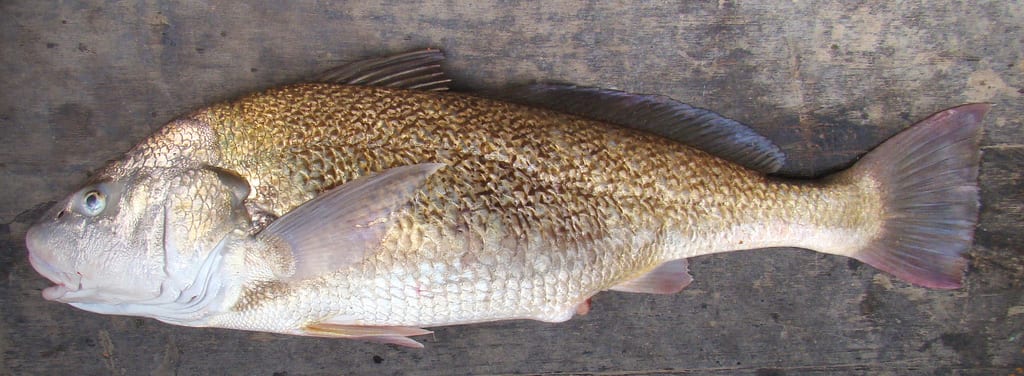
Taxonomy
- Kingdom
- Animalia
- Phylum
- Chordata
- Class
- Actinopterygii
- Order
- Perciformes
- Family
- Sciaenidae
- Genus
- Micropogonias
- Species
- furnieri
Habitat
Whitemouth croakers primarily inhabit coastal waters, estuaries, and bays with sandy or muddy bottoms in the Western Atlantic Ocean. They prefer shallow areas with moderate salinity and can tolerate both marine and brackish environments. This species is commonly found from the southeastern United States to Argentina.
Diet
Whitemouth croakers mainly feed on small crustaceans, polychaete worms, and bivalves scavenged from the ocean floor. They use their barbels to detect prey and are primarily bottom feeders, often foraging at night or during twilight hours. Their feeding behavior involves rooting through sediment to uncover food items.
Behavior
Whitemouth croakers form large schools for protection and migration, often exhibiting schooling behavior in open waters. They are primarily nocturnal, actively feeding at night, and can be territorial around feeding grounds. These fish produce drumming sounds with their swim bladders for communication, especially during spawning.
Fishing
Anglers target Whitemouth croakers with effective bottom fishing techniques, using light to medium tackle to handle their strong runs in shallow waters; cast with a 7-9 foot medium-action rod, 10-20 lb test line, and a simple Carolina rig with a 1-2 ounce sinker, size 1-2 hooks, and baits like live shrimp, bloodworms, or small crabs to mimic their diet of crustaceans and worms—jigs or soft plastic lures can also entice strikes. The best seasons are spring and summer during spawning migrations, with optimal times at night or dawn when they actively feed on the bottom; focus on coastal estuaries, bays, and sandy or muddy substrates in the Western Atlantic from the southeastern United States to Argentina, where they school in moderate salinity areas. Record sizes reach up to 8 pounds 13 ounces, with IGFA all-tackle records showcasing fish around this weight as testament to their fighting spirit. As a Least Concern species per IUCN, conservation efforts are bolstered by regulated fishing, including catch-and-release practices and slot limits that ensure population stability, with angler license fees directly funding habitat protection and stocking programs in these productive waterways, making recreational fishing a key tool for aquatic conservation.
Conservation Status
Listed as Least Concern by IUCN.