
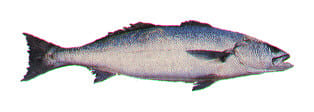
Overview
There are no barbels on the chin. A characteristic raised ridge exists along the midline of the belly between the vent and the base of the pelvic (ventral) fins. There is a black spot at the base of the pectoral fin. Adults are steel blue to gray above with golden highlights, silvery below. Young fish up to about 18 in (45 cm) may have 3 6 broad, dark vertical bars on the flanks, but these disappear with age.
Taxonomy
- Kingdom
- Animalia
- Phylum
- Chordata
- Class
- Actinopterygii
- Order
- Perciformes
- Family
- Sciaenidae
- Genus
- Atractoscion
- Species
- nobilis
Habitat
Inhabits the eastern Pacific between Magdalena Bay, Baja California, Mexico to Juneau Alaska. They are usually found near the mainland shore over sandy bottom or around near kelp beds, but they may also be found in shallow surf or deeper waters.
Diet
They eat sardines, anchovies, squid, small mackerel and other small fishes and crustaceans.
Behavior
White seabass are schooling fish, often forming loose groups in deeper waters during the day and moving to shallower areas at night to feed. They exhibit migratory patterns, moving inshore in warmer months and offshore in winter. These fish are primarily nocturnal hunters, using their excellent hearing to detect prey in low-light conditions, and they can be territorial around kelp beds or reefs.
Fishing
It may be taken by drift fishing or still fishing with live baits or by slow trolling, jigging or casting with feathers or small, flashy metal lures. Most are caught near the mainland shore and around Catalina and San Clemente Islands. The best fishing is said to be at night near the bottom. Off California the species is most numerous from about May to September. White seabass are a prized game fish and an excellent food species. The flesh spoils quickly, and should be eaten soon after capture.
Conservation Status
Listed as Least Concern by IUCN.