
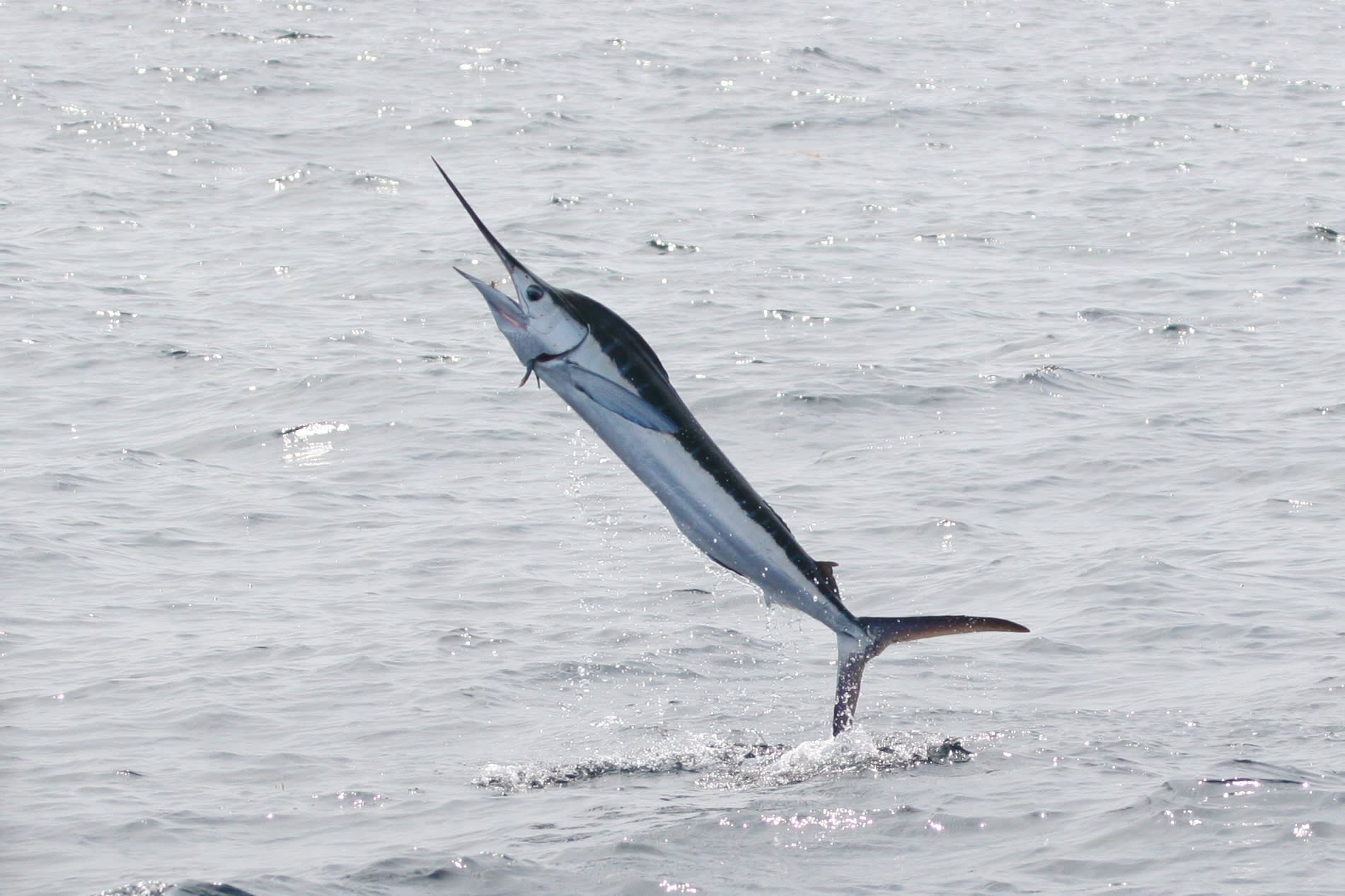
Overview
Its most characteristic feature is the rounded, rather than pointed, tips of the pectoral fins, first dorsal fin and first anal fin. Some specimens apparently vary from the norm in that the dorsal and pectoral fins may be more pointed; the anal fin is more consistently rounded than the others. The first dorsal fin resembles that of the striped marlin (T. audax) in that it is usually as high or higher than the greatest body depth. It differs from that of the striped marlin, or any other marlin, in that both margins are convex. The flat, movable pectoral fins can easily be folded flush against the sides of the body. The lateral line is visible and straight. In overall appearance the white marlin is generally lighter in color and tends to show more green than do other marlins. Several light blue or lavender vertical bars may show on the flanks, especially when the fish is feeding or leaping (see striped marlin coloration). Some specimens have a scattering of black or purple spots on the first dorsal and anal fins.
Taxonomy
- Kingdom
- Animalia
- Phylum
- Chordata
- Class
- Actinopterygii
- Order
- Perciformes
- Family
- Istiophoridae
- Genus
- Tetrapturus
- Species
- albidus
Habitat
Though this pelagic and migratory species is usually found in deep blue tropical and warm temperate waters, it frequently comes in close to shore where waters aren't much deeper than 8 fathoms.
Diet
White marlins primarily feed on small pelagic fish such as mackerel, flying fish, and tuna, as well as squid and occasionally crustaceans. They are active predators that use their long bills to slash and stun prey in open water. Feeding typically occurs during the day, especially in the morning and evening when prey schools are more active.
Behavior
White marlins are highly migratory, traveling long distances across the Atlantic and other oceans in search of food and warmer waters. They are often solitary or found in loose groups, exhibiting fast swimming and acrobatic leaps when hooked or during feeding. These fish are most active during the day in surface waters, showing territorial behavior when competing for prey.
Fishing
A top rated light tackle game fish, the white marlin can be caught by trolling with small whole or strip baits as well as with small spoons, feathers or any of a variety of other artificial lures. Live bait fishing with squid, ballyhoo, mullet, bonefish, mackerel, anchovies, herring and other fish is also successful. It feeds on whatever species are locally abundant
Conservation Status
Listed as Vulnerable by IUCN.