
Overview
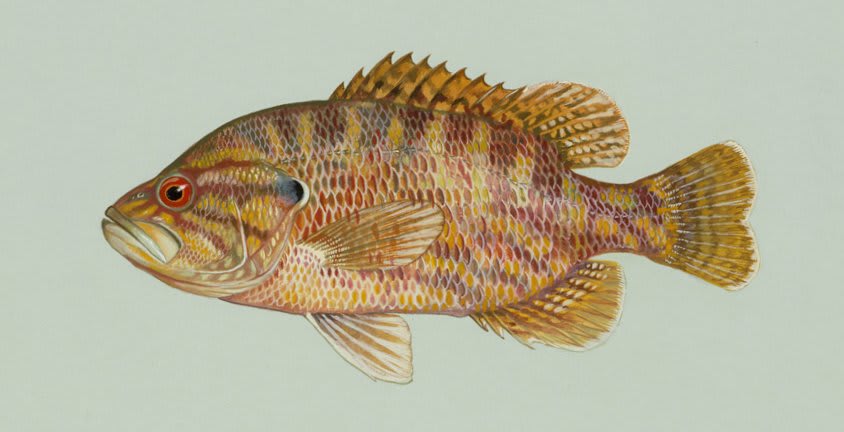
The warmouth is somewhat larger than either rock bass or green sunfish (with which it is often confused) but very similar otherwise in that it is large-mouthed and heavy-bodied. Adult warmouth are dark, with mottled brown coloration. Their belly is generally golden, and males have a bright orange spot at the base of the dorsal fin. Three to five reddish-brown streaks radiate from the eyes, and the gill flaps are often red. Warmouth have three spines in the anal fin, 10 spines in the dorsal fin, and small teeth are present on the tongue. They are sight feeders. When in breeding condition, the males' eyes turn red.
Taxonomy
- Kingdom
- Animalia
- Phylum
- Chordata
- Class
- Actinopterygii
- Order
- Cypriniformes
- Family
- Centrarchidae
- Genus
- Lepomis
- Species
- gulosus
Habitat
Can be found wherever dense weed beds and soft, muddy bottoms exist, and it is frequently caught near stumps. It is better able to tolerate turbid or muddy waters than most species. Warmouth are quite secretive. They seek cover in rocky banks, stumps or weeds, or near other large objects, where they can hide and wait for food.
Diet
Young warmouth feed on zooplankton and small insects. Adults feed on insects, mollusks, and small fish.
Behavior
Warmouth reach sexual maturity at 3 to 4 inches (7.5 to 10cm), and spawn in the spring, when water temperatures reach 71° F (21.5° C), and continuing through the summer. Males construct a disc-shaped nest by fanning their tails and removing silt and debris over nesting site. Nests are made in 1.5 to 4 feet (0.45 to 1.23 m) of water near a stump, clump of vegetation or other large, submerged object. Females produce 4,000 to 63,000 eggs during spawning season. After an incubation period of three days, the young hatch. The fry leave the nest five to six days after hatching and grow to 1 to 2 inches (25.4 to 50.8 mm) by the fall. After the female lays her eggs, the male fertilizes the eggs and aggressively defends the nest, eggs and fry from any intruder- including other females. Warmouth hybridize (crossbreed) with bluegill and green sunfish.
Fishing
Although it is an excellent panfish, it is not actively sought by a great many anglers. Because warmouth hit hard and are easily caught, they are popular with some anglers. They are good to eat when caught in clean water, but because they are bottom-feeders like catfish, the flesh can have a strong flavor.
Conservation Status
Listed as Least Concern by IUCN.