
Overview
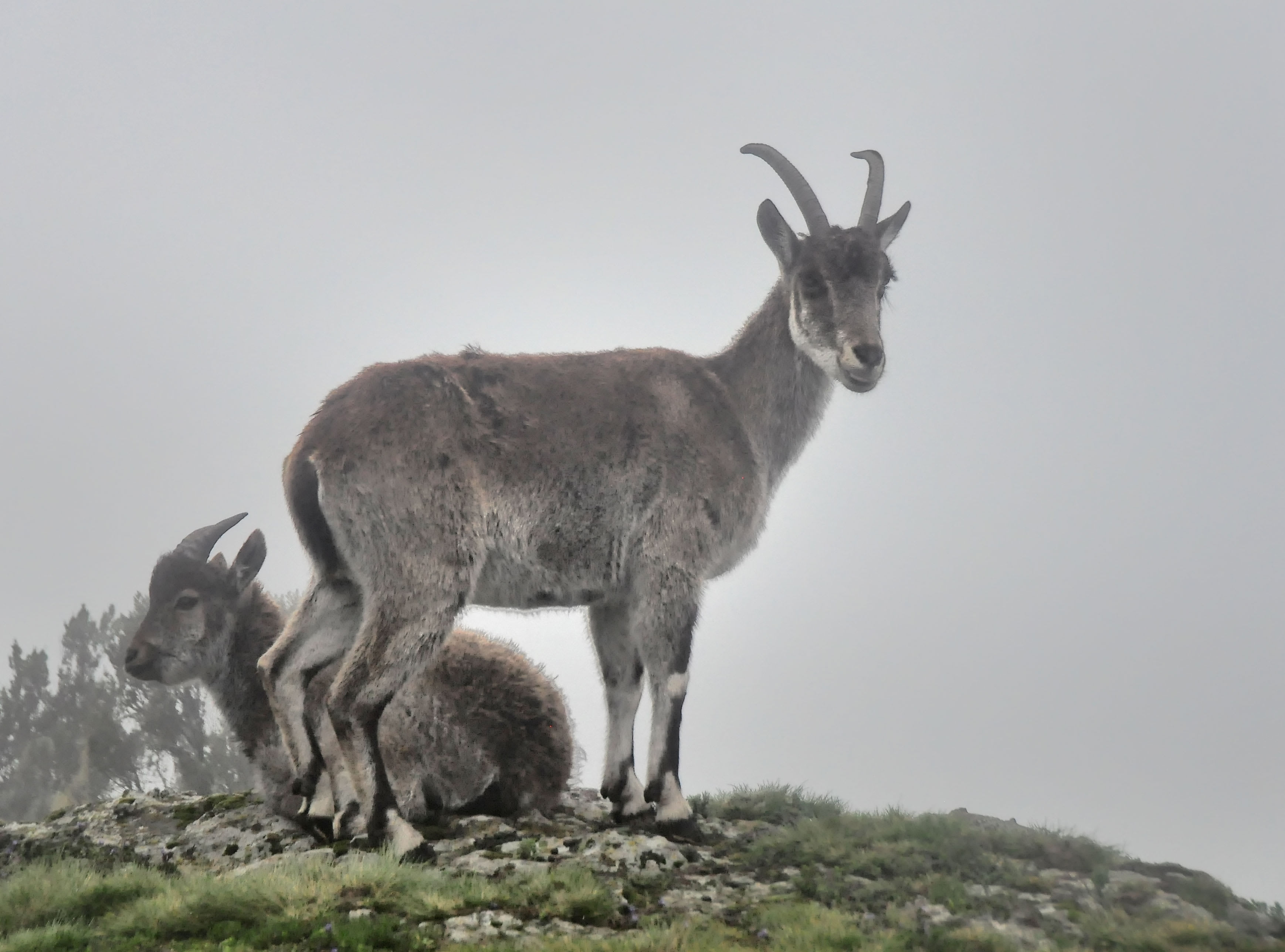
The walia ibex is larger than the Nubian ibex, with a stouter build, darker color, shorter beard and heavier horns. The general color is dark chestnut brown, and there are dark markings on the throat, chest and edges of the flanks. Chin and underparts are whitish. There are conspicuous black and white markings on the legs, a characteristic it shares with the Nubian ibex. Tail is short, with a stiff black tip. There are scent glands beneath the tail. The walia differs from all other ibex in having a bony protuberance, or boss, on its forehead. The male's horns form a half circle, and are shorter and thicker than those of the Nubian ibex, with fewer, more widely spaced cross ridges or knobs. Females are smaller than males, much lighter and duller in color, beardless, and grow short, curved horns of up to about 12 inches (30 cm) in length.
Taxonomy
- Kingdom
- Animalia
- Phylum
- Chordata
- Class
- Mammal
- Order
- Artiodactyla
- Family
- Bovidae
- Genus
- Capra
Habitat
Precipitous mountain slopes where there is considerable moisture and vegetation, usually at altitudes of 7,500-9,500 feet (2,300-2,900 m), but can be as high as 13,500 feet (4,100 m). Distribution- Found only in the Simien Mountains of north-central Ethiopia.
Diet
This animal both grazes and browses based on seasonal availability.
Behavior
Similar to the Nubian ibex, except that the walia has much more food and water available to it. Breeds throughout the year, but with a peak from March to May, usually with a single young, though often twins, born 5-1/2 months later. When a female gives birth, a group of adults will combine to protect her offspring from eagles.
Hunting
Not legally hunted.
Conservation Status
Listed as Endangered by IUCN. The total population of the species is estimated at around 500 individuals (probably less than 250 mature individuals total), largely confined to the Simien Mountains National Park. Although the population has been showing signs of increase over the past decade or so, the habitat continues to be degraded by human encroachment. (IUCN)