
Overview
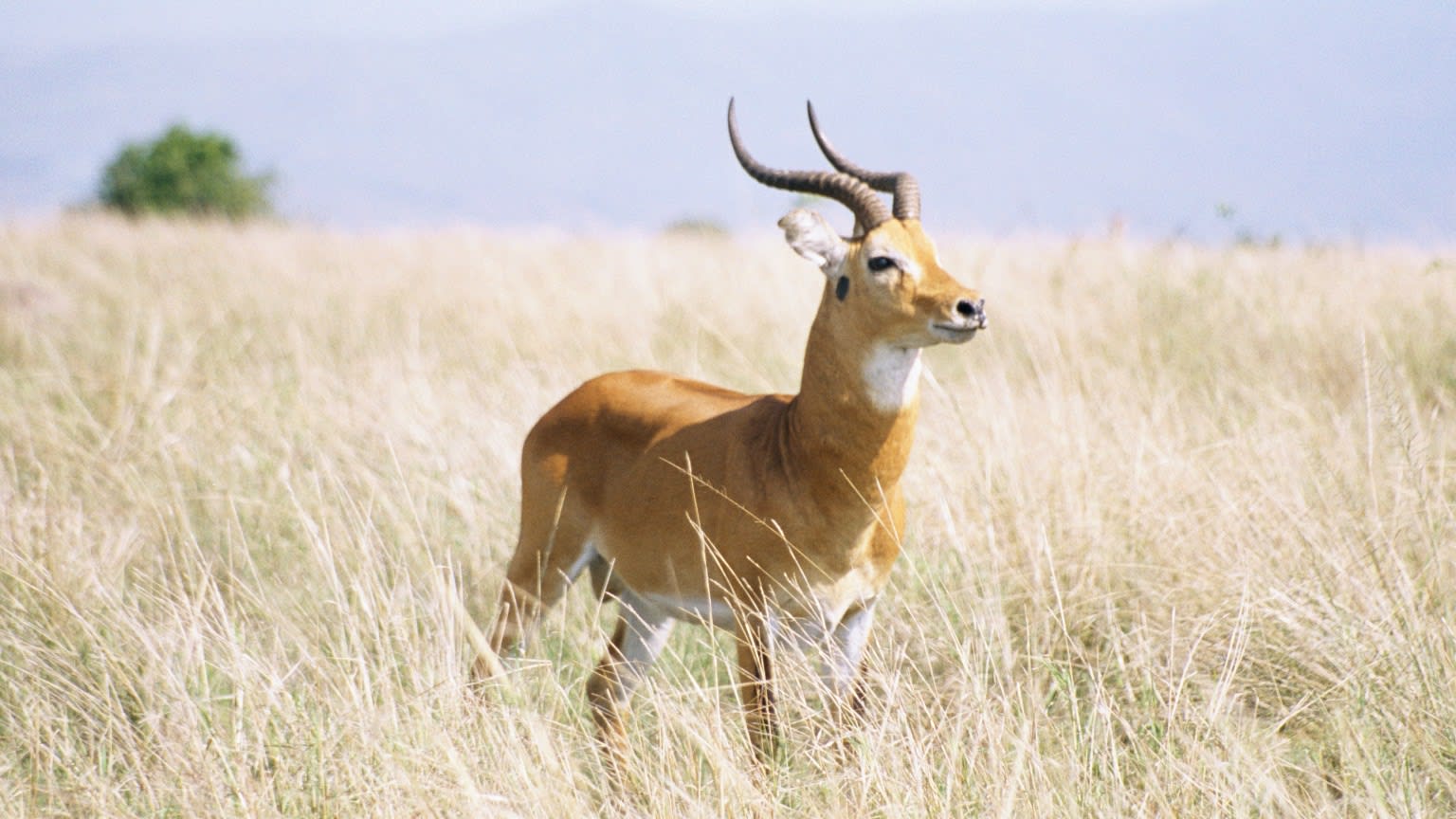
The Uganda Kob is somewhat larger in body and horns than the Western Kob, but is similar in size to the White-Eared Kob. Overall color is a rich reddish. The leg markings are a deeper black than in the Western Kob. The white areas of the throat and face are more extensive and distinct than in the Western Kob, but less so than in the White-Eared. Chin and muzzle are white, and there is a complete white ring around each eye. The back of the ears is buff, though the tips may be whitish.
Taxonomy
- Kingdom
- Animalia
- Phylum
- Chordata
- Class
- Mammal
- Order
- Artiodactyla
- Family
- Bovidae
- Genus
- Kobus
- Species
- Kobus kob
Habitat
Floodplains and savannah. Distribution- Northeastern Congo (K), western and northern Uganda, and southwestern Sudan west of the White Nile. Also in a narrow strip along the east bank of the White Nile in Sudan, from about the mouth of the Bahr-el-Ghazal southward to the Uganda border. Extinct in Kenya and Tanzania.
Diet
Primarily grazes on floodplain grasses and is water dependant.
Behavior
In general, Kobs occur in small herds of between 5 - 15 female animals with the males spaced apart. When the population density increases up to about 40 animals, they form a breeding arena called a 'lek'. Then hundreds of animals congregate in the area for mating opportunities. After a gestation period of around 8 months, one offspring is born.
Hunting
Spot and stalk methods. Hunted in Uganda.
Conservation Status
Listed as Least Concern by IUCN.