
Overview
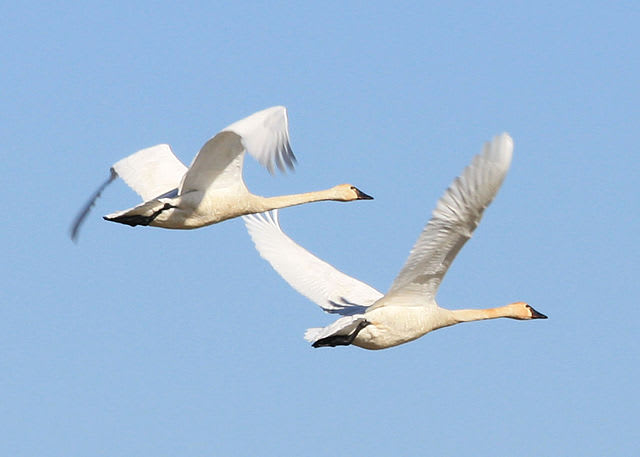
C. columbianus is the smallest of the Holarctic swans. In adult birds, the plumage of both subspecies is entirely white, with black feet, and a bill that is mostly black, with a thin salmon-pink streak running along the mouthline and – depending on the subspecies – more or less yellow in the proximal part. The iris is dark brown. In birds living in waters that contains large amounts of iron ions (e.g. bog lakes), the head and neck plumage acquires a golden or rusty hue. Pens (females) are slightly smaller than cobs (males), but do not differ in appearance otherwise.
Taxonomy
- Kingdom
- Animalia
- Phylum
- Chordata
- Class
- Bird
- Family
- Anatidae
- Genus
- Cygnus
- Species
- columbianus
Habitat
The breeding range of C. c. bewickii extends across the coastal lowlands of Siberia, from the Kola Peninsula east to the Pacific.
Diet
In summer, their diet consists mainly of aquatic vegetation—e.g. mannagrass (Glyceria), Potamogeton pondweeds and marine eelgrass (Zostera), acquired by sticking the head underwater or upending while swimming; they also eat some grass growing on dry land. At other times of year, leftover grains and other crops such as potatoes, picked up in open fields after harvest, make up much of their diet. Tundra swans forage mainly by day.
Behavior
The tundra swans mate in the late spring, usually after they have returned to the nesting grounds; as usual for swans, they pair monogamously until one partner dies. Should one partner die long before the other, the surviving bird often will not mate again for some years, or even for its entire life. The nesting season starts at the end of May. The pair build the large mound-shaped nest from plant material at an elevated site near open water, and defend a large territory around it. The pen (female) lays and incubates a clutch of 2–7 (usually 3–5) eggs, watching for danger while sitting on the nest. The time from laying to hatching is 29–30 days for Bewick's swan and 30–32 days for the whistling swan. Since they nest in cold regions, tundra swan cygnets grow faster than those of swans breeding in warmer climates; those of the whistling swan take about 60–75 days to fledge—twice as fast as those of the mute swan for example—while those of Bewick's swan, about which little breeding data is known, may fledge a record 40–45 days after hatching already. The fledglings stay with their parents for the first winter migration. The family is sometimes even joined by their offspring from previous breeding seasons while on the wintering grounds; Tundra swans do not reach sexual maturity until 3 or 4 years of age.
Hunting
Hunted across its range.
Conservation Status
Listed as Least Concern by IUCN.