
Overview
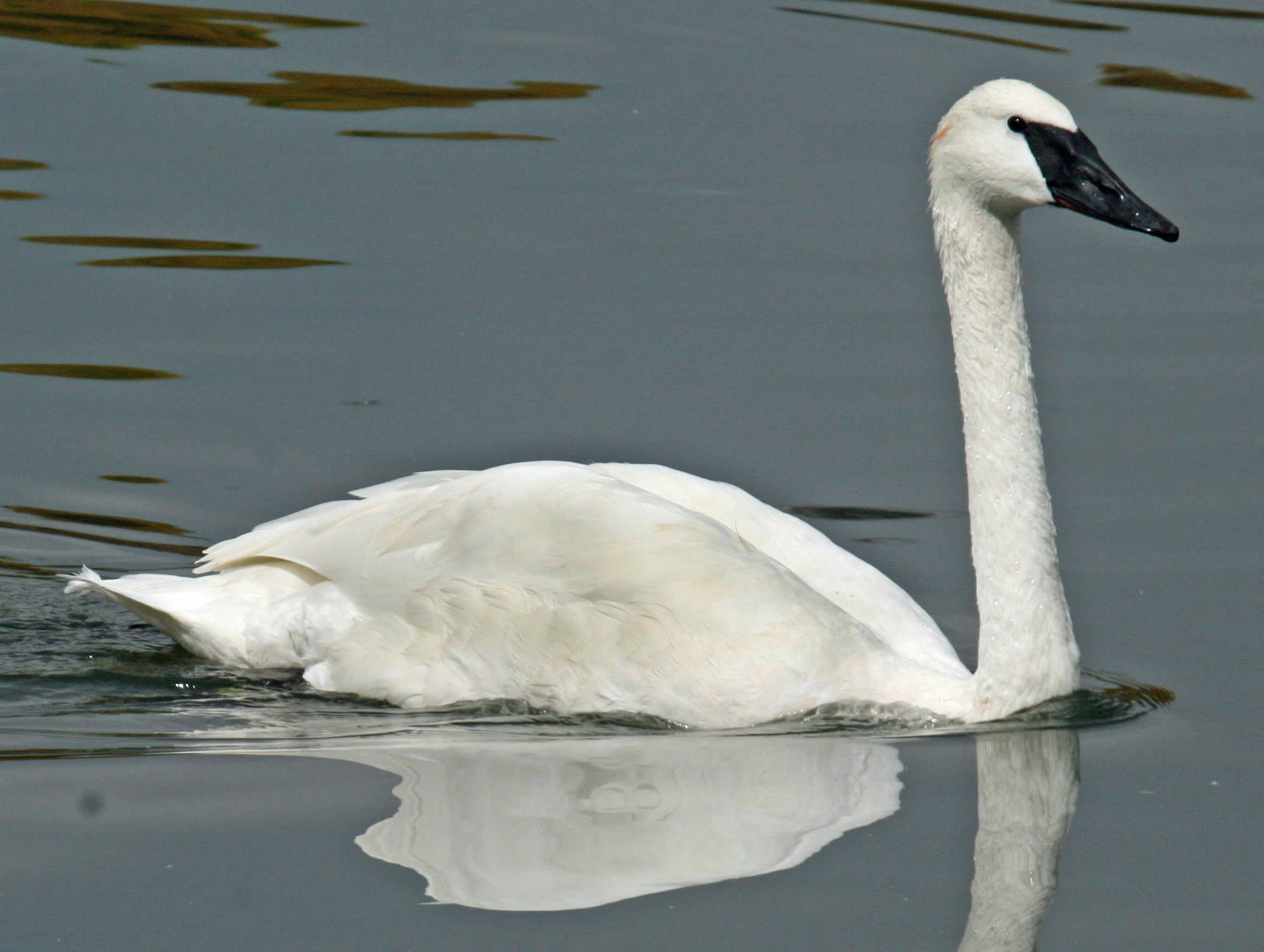
The adult trumpeter swan is all white in plumage. Like mute swan cygnets, the cygnets of the trumpeter swan have light grey plumage and pinkish legs, and gain their white plumage after about a year. As with a whooper swan, this species has upright posture and generally swims with a straight neck. The trumpeter swan has a large, wedge-shaped black bill that can, in some cases, be minimally lined with salmon-pink coloration around the mouth. The bill, measuring 10.5–12 cm (4.1–4.7 in), is up to twice the length of a Canada goose's (Branta canadensis) bill and is the largest of any waterfowl. The legs are gray-pink in color, though in some birds can appear yellowish gray to even black. The tarsus measures 10.5–12 cm (4.1–4.7 in). The mute swan, introduced to North America, is scarcely smaller. However, it can easily be distinguished by its orange bill and different physical structure (particularly the neck, which is always curved down as opposed to straight in the trumpeter). The mute swan is often found year-around in developed areas near human habitation in North America, whereas trumpeters are usually only found in pristine wetlands with minimal human disturbance, especially while breeding. The tundra swan (C. columbianus) more closely resembles the trumpeter, but is significantly smaller. The neck of a male trumpeter may be twice as long as the neck of a tundra swan. The tundra swan can be further distinguished by its yellow lores. However, some trumpeter swans have yellow lores; many of these individuals appear to be leucistic and have paler legs than typical trumpeters. Distinguishing tundra and trumpeter swans from a distance (when size is harder to gauge) can be challenging without direct comparison but it is possible thanks to the trumpeter's obviously longer neck (the great length of which is apparent even when the swan is not standing or swimming upright) and larger, wedge-shaped bill as compared to the tundra swan.
Taxonomy
- Kingdom
- Animalia
- Phylum
- Chordata
- Class
- Bird
- Family
- Anatidae
- Genus
- Cygnus
- Species
- buccinator
Habitat
Their breeding habitat is large shallow ponds, undisturbed lakes, pristine wetlands and wide slow rivers, and marshes
Diet
Aquatic plants.
Behavior
Like other swans, Trumpeter swans often mate for life, and both parents participate in raising their young, but primarily the female incubates the eggs. Most pair bonds are formed when swans are 5 to 7 years old, although some pairs do not form until they are nearly 20 years old. Divorces have been known between birds, in which case the mates will be serially monogamous, with mates in differing breeding seasons. Occasionally, if his mate dies, a male trumpeter swan may not pair again for the rest of his life. Most egg laying occurs between late April and May. The female lays 3–12 eggs, with 4 to 6 being average, in a mound of plant material on a small island, a beaver or muskrat lodge, or a floating platform on a clump of emergent vegetation. The same location may be used for several years and both members of the pair help build the nest. The nest consists of a large, open bowl of grasses, sedges and various aquatic vegetation and have ranged in diameter from 1.2 to 3.6 m (3.9 to 11.8 ft), the latter after repeated uses. The eggs average 73 millimetres (2.9 in) wide, 113.5 millimetres (4.5 in) long, and weigh about 320 grams (11.3 oz).The eggs are quite possibly the largest of any flying bird alive today, in comparison they are about 20% larger in dimensions and mass than those of an Andean condor (Vultur gryphus), which attains similar average adult weights, and more than twice as heavy as those of kori bustards (Ardeotis kori).The incubation period is 32 to 37 days, handled mainly by the female, although occasionally by the male as well. The young are able to swim within two days and usually are capable of feeding themselves after, at most, two weeks. The fledging stage is reached at roughly 3 to 4 months. While nesting, trumpeter swans are territorial and harass other animals, including conspecifics, who enter the area of their nest. Adults go through a summer moult when they temporarily lose their flight feathers. The females become flightless shortly after the young hatch; the males go through this process about a month later when the females have completed their moult.
Hunting
No hunting season currently exists.
Conservation Status
Listed as Least Concern From 1968 to 2010 the population has increased from 3,722 to approximately 46,225 birds, in large part due to re-introductions to its historic range.by IUCN.