
Overview
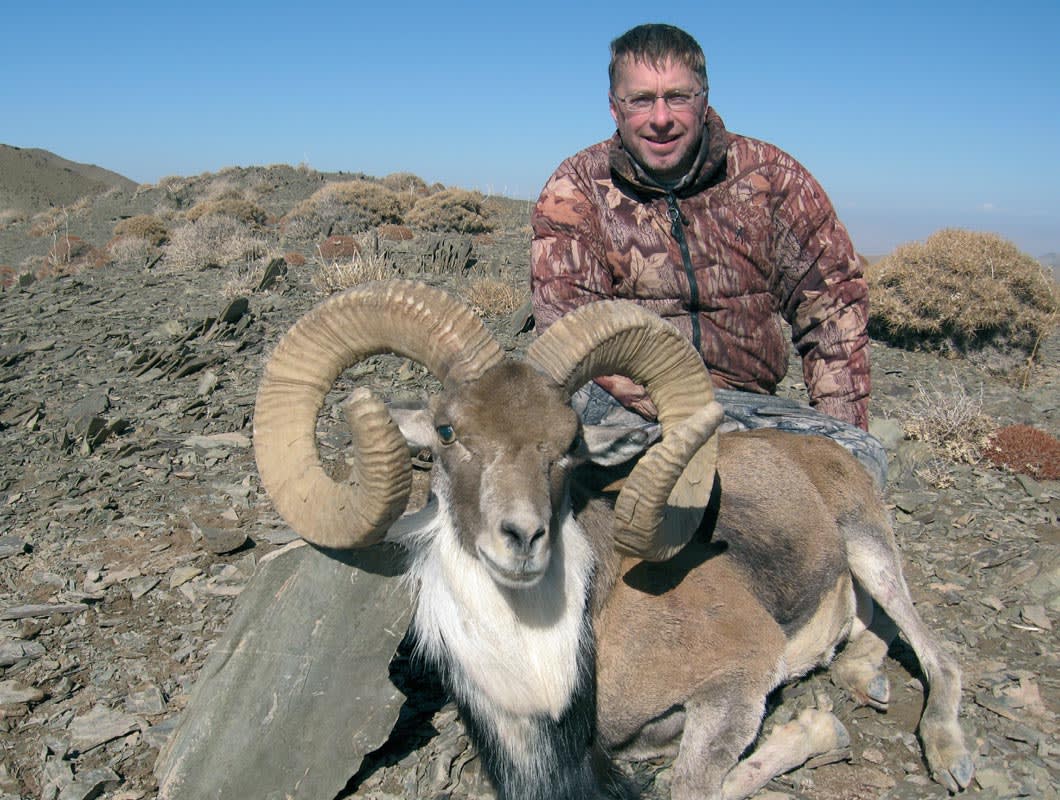
The urial is considered one of the smaller species of wild sheep. They have a long flowing neck, bib, and ruff that can measure over 9 inches (23 cm). It is a large, bright-colored urial. Adult rams have a white bib, and a long white neck ruff; immature males have a smaller, dark neck ruff. Upper parts are uniformly tawny-brown. Rump patch, muzzle, belly and lower legs are white, and there is a darker stripe separating the belly and upper body. No saddle patch, but some males have a dark shoulder spot in their winter coat. The horns are rather long and homonymous, growing in a tight circle or forming an open spiral. The frontal horn surface is flat, with sharp angles and distinct ridges, triangular in cross section. Females have short, straight horns.
Taxonomy
- Kingdom
- Animalia
- Phylum
- Chordata
- Class
- Mammal
- Order
- Artiodactyla
- Family
- Bovidae
- Genus
- Ovis
- Species
- Urial, vignei
Habitat
Grassy slopes below the timberline. They rarely move to the rocky areas of the mountains.
Diet
Primarily graze but will browse when necessary.
Behavior
The mating season begins in September across this animal's native habitat. Rams will determine hierarchy based on age, aggression, and horn size, often battling other males for the right to breed. Dominant males will select 4-5 ewes, who will give birth to one or two lambs after 5 months of gestation.
Hunting
The best hunting months in their native range are November through March, and on high fence ranches in North America they can be hunted year round. In their native habitat, and habitat that resembles their native habitat, they are primarily hunted by any number of spot and stalk methods, or waiting in an area with visibility in a known travel route. Proper glassing equipment, footwear, pysical stamina, and a medium caliber rifle sighted in for longer ranges is preferred. A 300. win mag and similair calibers work well for this type of hunting. On private ranches they can be hunted by any means acceptible to the outfitter and legal in that area. Many are hunted on high fence ranches, but there are still opportunities to hunt them in their native range. The hunts in their native range are undoubtly more costly and difficult due to the terrain and travel to and from the countries that it can be hunted. When traveling to their native range, a properly vetted outfitter is a necessity.
Conservation Status
Outside of their native range they can be found on private game ranches.