
Overview
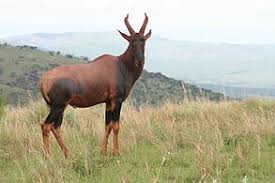
The topi is the smallest of the topi group (topi, tiang and korrigum) and grows the smallest horns. It is darker and more richly colored than either the korrigum or tiang. Its general color is a rich reddish brown with a strong, iridescent purplish gloss. The purplish black patches on shoulders, hips and upper legs are darker and more extensive, extending down the front legs to form a garter above the knee. As in the tiang, the lower legs are bright tan, contrasting with the reddish body color. There is no dark stripe from the facial blaze through the eye. The horns (both sexes) are small, notably shorter and slimmer than in the korrigum or tiang.
Taxonomy
- Kingdom
- Animalia
- Phylum
- Chordata
- Class
- Mammal
- Order
- Artiodactyla
- Family
- Bovidae
- Genus
- Damaliscus
- Species
- Damaliscus lunatus
Habitat
Grasslands and savanna woodlands, sometimes in arid country. Distribution- Parts of extreme eastern Congo (K) adjacent to Uganda; in southwestern and eastern Uganda; southwestern and southeastern Kenya; southwestern Somalia; Rwanda; and western and northern Tanzania.
Diet
Exclusively a grazer, able to thrive on dry grasses not eaten by other antelopes.
Behavior
Highly gregarious, it lives in herds of 15-30, sometimes hundreds, or even thousands during seasonal migrations in search of new grass during the early rains. Often mingles with other species such as zebra, wildebeest and hartebeest. Breeding males are territorial during the rut, each defending a well-marked stamping ground against other males, through which females and juveniles wander freely. After the rut the herds split, with males and females forming groups by themselves. Eyesight, hearing and sense of smell are good. A very fast runner, probably as swift as the tsessebe.
Hunting
Topi are hunted using spot-and-stalk methods in the open grasslands of East Africa, leveraging their gregarious nature and seasonal migrations to spot herds from elevated positions or vehicles before closing in for a shot; driven hunts can also be effective in certain conservancies. Opt for a bolt-action rifle chambered in .270 Winchester, .308 Winchester, or .300 Winchester Magnum for their balance of accuracy and power, paired with premium expanding bullets to ensure quick, humane kills by targeting the heart-lung area just behind the shoulder; a good binocular and rangefinder are essential for identifying trophy animals at distance. The best hunting season aligns with the dry months from June to October, when Topi congregate in search of water and fresh grass, making them easier to locate and increasing chances for mature males during the rut. For trophy criteria, focus on males with well-formed, curved horns measuring at least 24-28 inches as per Safari Club International (SCI) records, which recognize exceptional specimens for their symmetry and length. Legal hunting for Topi is available in regions like northern Tanzania, southwestern Kenya, and Uganda, primarily through licensed outfitters on private game ranches and community conservancies, where hunting fees generate vital revenue for anti-poaching patrols and habitat conservation programs—much like Southern African models—that have sustained Topi populations as Least Concern under IUCN assessments through effective management.
Conservation Status
Listed as Least Concern by IUCN, but this refers to the species as a whole, not the Topi subspecies.