
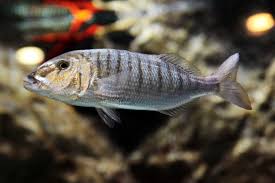
Taxonomy
- Kingdom
- Animalia
- Phylum
- Chordata
- Class
- Actinopterygii
- Order
- Siluriformes
- Family
- Sparidae
- Genus
- Lithognathus
- Species
- mormyrus
Habitat
This species inhabits shallow coastal waters, typically over sandy or rocky bottoms in depths up to 150 meters. It prefers areas with seagrass beds, reefs, or estuaries in the Atlantic Ocean, Mediterranean Sea, and western Indian Ocean. These environments provide cover and abundant food sources.
Diet
The striped seabream feeds primarily on benthic invertebrates such as crabs, worms, and mollusks. It also consumes small fish and algae, often foraging in groups during daylight hours. Feeding behavior involves rooting through the substrate to uncover prey.
Behavior
Striped seabream are schooling fish that form groups for protection and feeding, often seen swimming near the bottom. They are diurnal, active during the day and resting at night, and exhibit territorial behavior around feeding sites. This species is generally wary of predators and uses its stripes for camouflage.
Fishing
Anglers targeting the striped seabream, a popular sport fish in the Atlantic, Mediterranean, and Indian Ocean regions, can employ effective bottom fishing techniques using light tackle to mimic its natural foraging behavior over sandy or rocky bottoms and seagrass beds in shallow coastal waters up to 150 meters; cast with a medium-light spinning rod paired with a 2000-4000 size reel, 10-20 lb test line, and a simple Carolina rig or drop shot setup for precision, baited with live worms, crabs, or small mollusks to attract these schooling fish during their daytime feeding frenzies. The best seasons are late spring through summer when they spawn and are most active, particularly in the morning and late afternoon for optimal bites in estuaries, reefs, and seagrass areas of Morocco, Albania, or the Mediterranean Sea. Typical sizes range from 20-40 cm, with records showing individuals up to 50 cm and weighing around 1 lb 12 oz, though the IGFA all-tackle world record isn't prominently listed, highlighting the importance of ethical angling. Conservation efforts, supported by angler license fees and excise taxes, ensure healthy populations through slot limits and catch-and-release practices in many regions, which are effective management tools that maintain stable stocks and protect vital habitats, as evidenced by the species' IUCN Least Concern status—making recreational fishing a key contributor to aquatic conservation funding and waterway restoration programs.
Conservation Status
Listed as Least Concern by IUCN.