
Overview
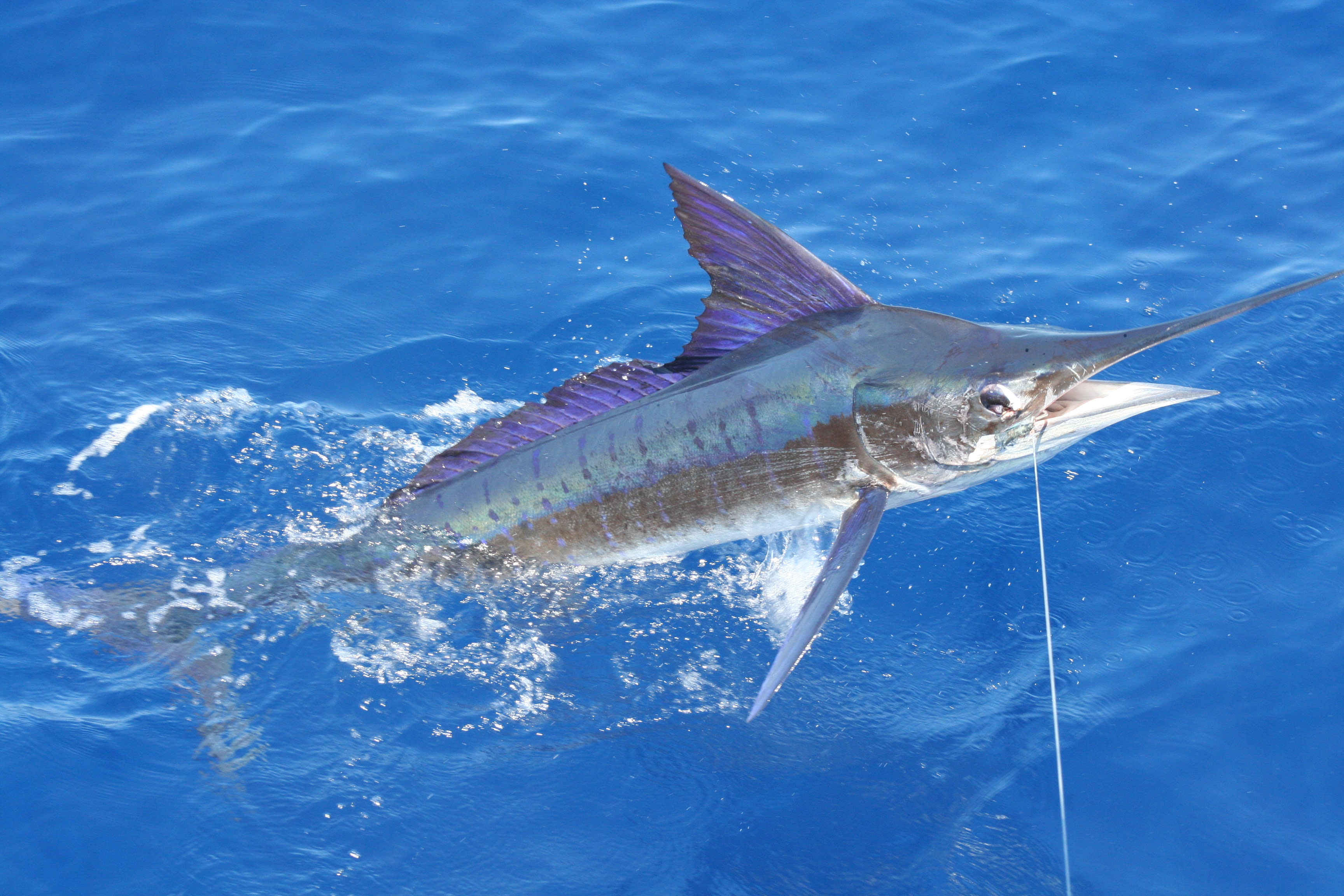
The most distinguishing characteristic is its high, pointed first dorsal fin, which normally equals or exceeds the greatest body depth. Even in the largest specimens this fin is at least equal to 90 percent of the body depth. Like the dorsal fin, the anal and pectoral fins are pointed. They are also flat and movable and can easily be folded flush against the sides, even after death. The sides are very compressed. The lateral line is straight, single and clearly visible. The back is steely blue fading to bluish silver on the upper flanks and white below the lateral line. There are a number of iridescent blue spots on the fins and pale blue or lavender vertical stripes on the sides. These may or may not be prominent, but they are normally more prominent than those of other marlins, and they persist after death, which is not always true on other marlins.
Taxonomy
- Kingdom
- Animalia
- Phylum
- Chordata
- Class
- Actinopterygii
- Order
- Perciformes
- Family
- Istiophoridae
- Genus
- Tetrapturus
- Species
- audax
Habitat
Striped marlin are pelagic fish found in open ocean waters, typically in temperate and tropical regions with surface temperatures above 18°C. They prefer areas with upwelling currents that bring nutrient-rich waters, supporting abundant prey, and are often encountered near continental shelves or oceanic islands. Their migratory behavior takes them toward the equator in cooler months and poleward in warmer ones.
Diet
It is highly predatory, feeding extensively on pilchards, anchovies, mackerel, sauries, flying fish, squid, and whatever is abundant.
Behavior
the Striped Marlin is pelagic and seasonally migratory, moving toward the equator during the cold season and away again during the warm season.
Fishing
It is well known for its fighting ability and has the reputation of spending more time in the air than in the water after it is hooked. In addition to long runs and tail walks, it will “greyhound” across the surface, making up to a dozen or more long, graceful leaps. It can be caught fairly close to shore, and lacking the size and weight of the Blue Marlin or the Black Marlin, it is more acrobatically inclined. Fishing methods include trolling whole fish, strip baits, or lures; also live bait fishing.
Conservation Status
Listed as Vulnerable by IUCN.