
Overview
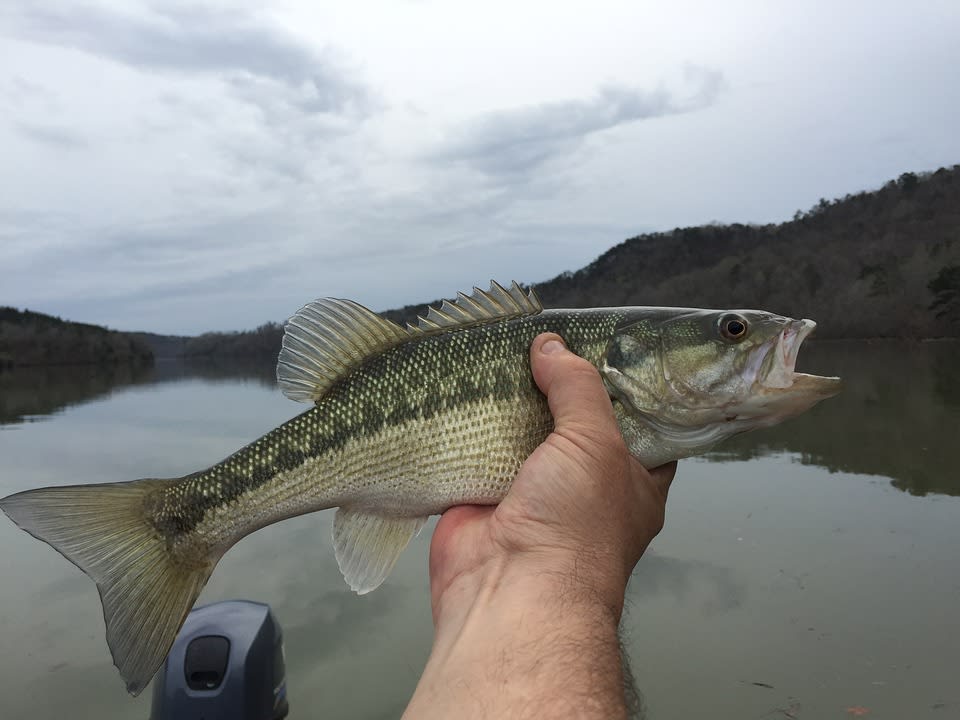
There are three recognized subspecies of the spotted bass: the northern spotted bass (Micropterus punctulatus punctulatus), the Alabama spotted bass (Micropterus p. henshalli), and the Wichita spotted bass (Micropterus p. wichitae). The spotted bass, like all black basses except the largemouth, has scales on the base portion of the second dorsal fin, its first and second dorsal fin are clearly connected, and its upper jaw bone does not extend back to or beyond the rear edge of the eyes. The spotted bass is also often confused with the smallmouth bass (M. dolomieu), but it lacks the vertical bars that are present on the sides of the body in the smallmouth. The spotted bass also has small black spots below the lateral line (the rear edges of certain scales are black) unlike either the largemouth or the smallmouth. Juveniles of the species resemble the young of smallmouth bass in having a broad band of orange at the base of the tail, followed by a broad black band and white edge. Because of the difficulty in recognizing the species, it is probable that record size specimens of spotted bass have gone unnoticed.
Taxonomy
- Kingdom
- Animalia
- Phylum
- Chordata
- Class
- Actinopterygii
- Order
- Cypriniformes
- Family
- Centrarchidae
- Genus
- Micropterus
- Species
- punctulatus
Habitat
Spotted bass seem to be segregated by Habitat type from closely related species. They tend to be found in areas with more current than largemouth bass, and they usually inhabit areas that are too warm, turbid, and sluggish for smallmouth bass. They prefer cool and warm mountain streams and reservoirs with rocky bottoms.
Diet
As young fish grow their diet shifts from zooplankton to insects, and finally to fish and crayfish.
Behavior
Although a large proportion reach maturity within a year, spotted bass found in spawning areas are usually three to four years old. Rock and gravel are usually chosen as suitable spawning areas at water temperatures of 57-74°F. Nest depths may vary widely. Females may lay between 1,150 and 47,000 eggs. Males guard the eggs during incubation and for up to four weeks after they have hatched.
Fishing
Many anglers who catch a spotted bass believe they have caught a largemouth bass (M salmoides), undoubtedly because the coloration is similar, both having a greenish hue and a broad stripe of diamonds or blotches along the midline of the body. They are excellent fighters; Spotted bass are very popular in east Texas, particularly in the Sabine, Neches, and Cypress Rivers. Known maximum size in Texas exceeds 5.5 pounds.
Conservation Status
Listed as Least Concern by IUCN.