
Overview
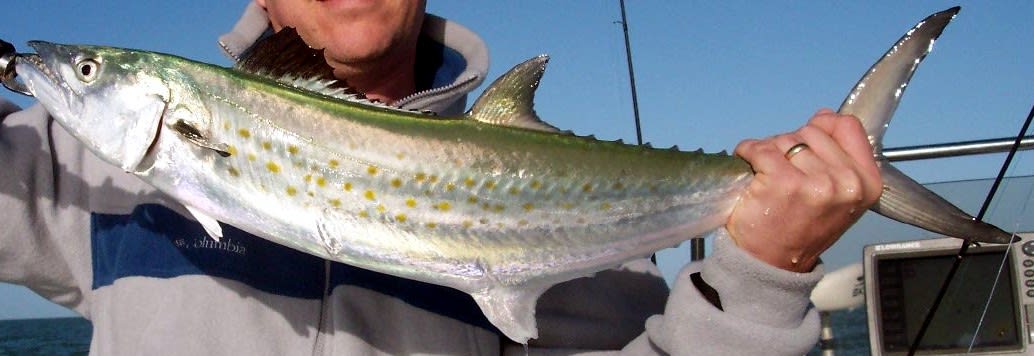
The Spanish Mackerel can be distinguished from both the cero mackerel, Scomberomorus regalis, and the king mackerel, S. cavalla, by the presence of bronze or yellow spots but no stripes, on the sides and by the lack of scales on the pectoral fins. The cero, the Spanish Mackerel's closest look alike in the Atlantic, has both spots and stripes of bronze or yellow on the sides, and the King Mackerel has neither spots nor stripes. Both the cero and the king mackerel have scales on the pectoral fins. The anterior portion of the first dorsal fin in the Spanish Mackerel is black (not true of the King Mackerel), and the second dorsal fin and pectoral fins may be black tipped. The body is essentially silvery and typically Mackerel like. The back is bluish.
Taxonomy
- Kingdom
- Animalia
- Phylum
- Chordata
- Class
- Actinopterygii
- Order
- Perciformes
- Family
- Scombridae
- Genus
- Scomberomorus
- Species
- maculatus
Habitat
Spanish mackerel primarily inhabit coastal and offshore waters of the western Atlantic, from Cape Cod to the Yucatan Peninsula, often over continental shelves. They prefer warm, temperate to tropical seas with temperatures above 68°F, frequently found near the surface around reefs, structures, or areas with strong currents. These fish are pelagic but can enter bays and estuaries during migrations.
Diet
Spanish mackerel primarily feed on small fish such as sardines, anchovies, and menhaden, along with squid and shrimp. They exhibit aggressive, fast-chasing feeding behavior in schools, often striking at prey near the surface. Feeding activity peaks during daylight hours, especially in early morning and late afternoon when baitfish are most active.
Behavior
Spanish mackerel are highly social and form large, fast-moving schools that migrate seasonally along coastlines. They are diurnal predators, actively hunting in open water and showing aggressive strikes when feeding. These fish can be territorial around prime feeding areas and are known for their rapid, evasive maneuvers to avoid threats.
Fishing
This is an excellent game fish that can be taken on a wide variety of lures and baits. Nylon jigs are considered one of the best lures, especially when retrieved rapidly with an occasional jerk of the rod tip to impact a darting motion to the jig. Feather lures and spoons are also successful, while minnows and live shrimp are the best natural baits. Occasionally almost any lure or bait will work, while at other times, nothing will. Spanish mackerel are a good food fish and although they are considered large at 10 lb (4.53 kg) some record specimens will grow to more than twice that size.
Conservation Status
Listed as Least Concern by IUCN.