
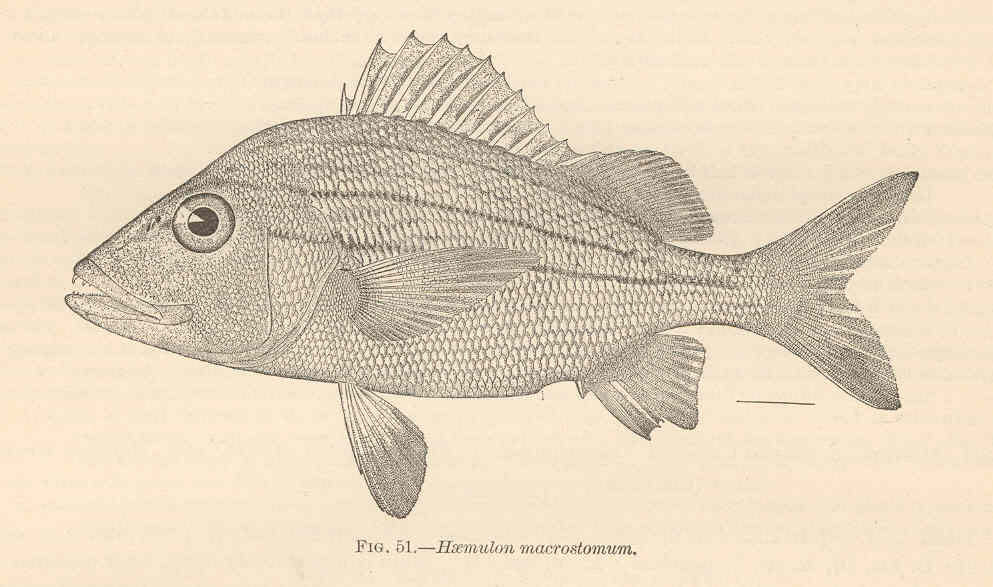
Taxonomy
- Kingdom
- Animalia
- Phylum
- Chordata
- Class
- Actinopterygii
- Order
- Perciformes
- Family
- Haemulidae
- Genus
- Haemulon
- Species
- macrostomum
Habitat
Spanish grunts primarily inhabit coral reefs, rocky areas, and seagrass beds in shallow to moderate depths up to 30 meters. They are commonly found in the western central Atlantic Ocean, preferring warm tropical and subtropical waters around islands and continental shelves. This species avoids very deep or open ocean environments.
Diet
Spanish grunts feed mainly on small crustaceans, mollusks, polychaete worms, and occasionally small fish or algae. They are primarily nocturnal foragers, using their sensitive barbels to detect prey on the seafloor during nighttime hours. This feeding behavior helps them avoid daytime predators in reef environments.
Behavior
Spanish grunts are schooling fish that form large groups for protection and foraging, often seen swimming close to the bottom during the day and becoming more active at night. They exhibit territorial behavior around feeding areas and produce grunting sounds to communicate, especially during courtship or when threatened. This species is generally wary of divers and boats, quickly darting into crevices for cover.
Fishing
Target Spanish grunts, a popular reef fish in the western central Atlantic from Florida to the Caribbean, using bottom fishing techniques with light tackle for an exciting catch that supports conservation through angler-funded programs; cast with a 6- to 8-foot medium-light rod paired with a 2000-3000 series reel spooled with 10- to 15-pound test line, and use a simple bottom rig with a sinker to keep bait near the seafloor, employing baits like shrimp, squid, or small crabs to mimic their natural diet of crustaceans and mollusks for effective strikes. The best season runs from spring through summer when they spawn in warmer waters, with prime fishing times at night when they actively forage, enhancing your chances in shallow coral reefs, rocky areas, or seagrass beds up to 30 meters deep—focus on structure-rich zones around islands and continental shelves for schooling groups. Spanish grunts typically reach 20-30 cm, with records up to 45 cm and 1 lb 4 oz, though no official IGFA all-tackle record exists, making personal bests a thrill; always check local regulations, such as bag limits or size slots in places like Florida, which serve as effective management tools to maintain healthy populations and support stocking programs that protect these vibrant ecosystems through license fees and habitat restoration efforts—practice catch-and-release to ensure sustainable fishing and contribute to their stable, Least Concern status as outlined by the IUCN.
Conservation Status
Listed as Least Concern by IUCN.