
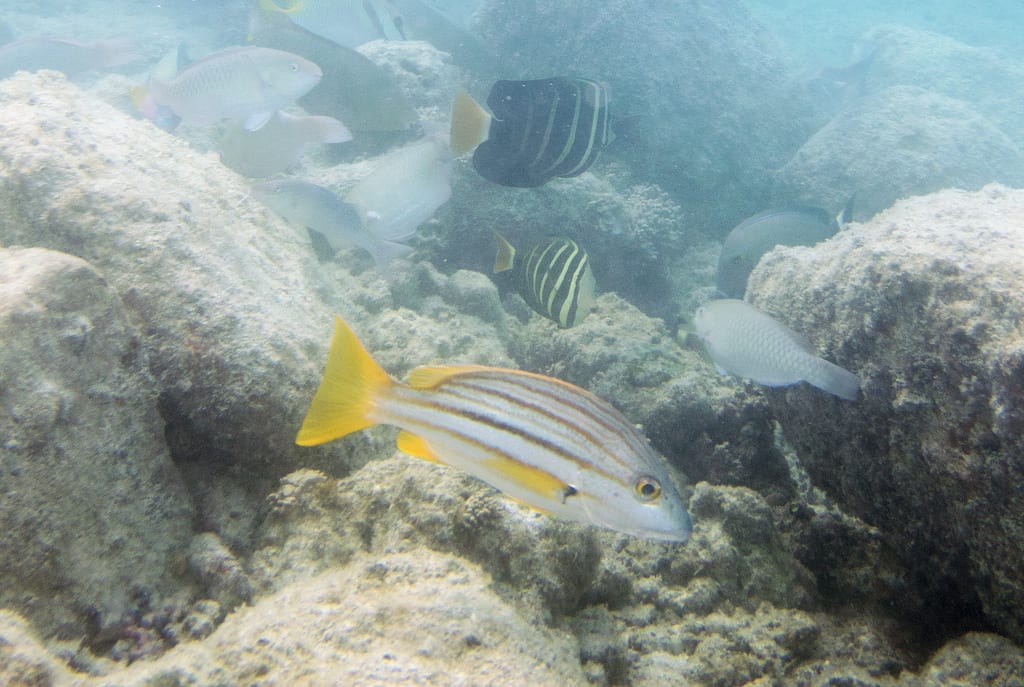
Taxonomy
- Kingdom
- Animalia
- Phylum
- Chordata
- Class
- Actinopterygii
- Order
- Perciformes
- Family
- Lutjanidae
- Genus
- Lutjanus
- Species
- carponotatus
Habitat
This species primarily inhabits coral reefs, lagoons, and rocky substrates in the Indo-West Pacific, including areas around Singapore, the Southern Islands, and Australia. They prefer shallow to moderate depths of 10-50 meters, where they can find shelter among structures and abundant prey.
Diet
Spanish flag snappers feed mainly on small fish, crustaceans, and mollusks, which they hunt by ambushing or foraging in groups. They are diurnal feeders, actively searching for food during the day in reef environments.
Behavior
These snappers form schools for protection and feeding, and they are primarily diurnal, being most active during daylight hours. They exhibit territorial behavior around coral structures and use camouflage or hiding spots to evade threats.
Fishing
Target the Spanish flag snapper, a prized sport fish in the Indo-West Pacific regions like Singapore, Southern Islands, and Australia, by using effective techniques such as bottom fishing or jigging around coral reefs, lagoons, and rocky substrates in depths of 10-50 meters to mimic their ambush hunting style. Opt for medium-light tackle, including a 6-9 foot rod with 10-20 lb test line, reels with good drag for reef structure, and size 1/0 to 3/0 hooks baited with live crustaceans, small fish, or mollusks; artificial lures like jigs and soft plastics that imitate their prey are highly effective for enticing strikes. The best season is during warmer months when they spawn and feed actively, with peak times being daylight hours when these diurnal fish are most aggressive; focus your efforts early morning or late afternoon for optimal results. These snappers typically grow to 30-50 cm and up to 1 lb 8 oz, supporting sustainable angling traditions, though specific IGFA records are not established—anglers contribute to conservation by adhering to local regulations, practicing catch-and-release to bolster population health, and funding habitat protection through license fees that aid in maintaining vibrant reef ecosystems.
Conservation Status
Listed as Not Evaluated by IUCN.