
Overview
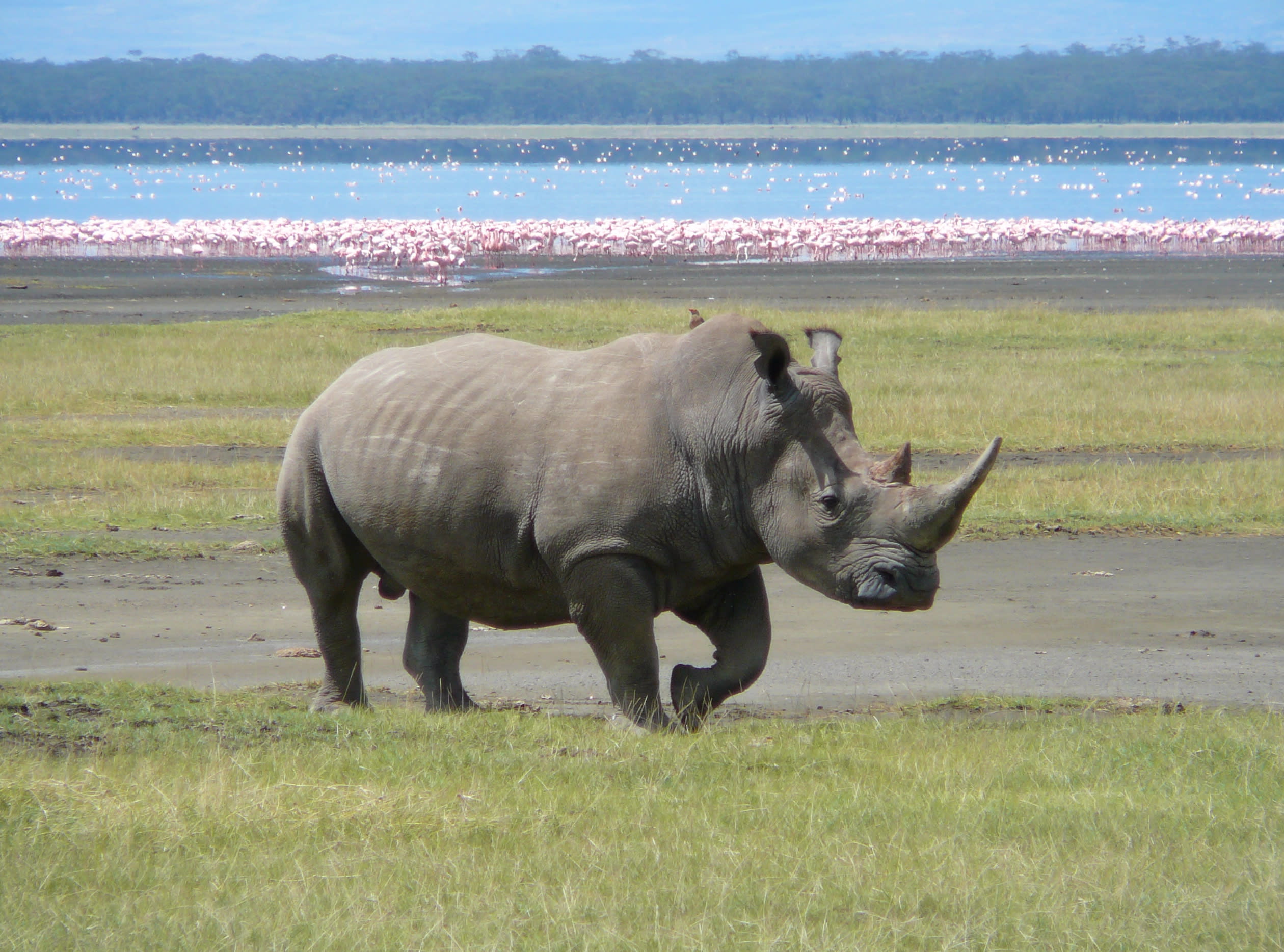
White rhinos are the second largest land mammal after the elephant. White rhinos are also known as the square-lipped rhinoceros due to their square (not pointed) upper lip. Their name comes from the Afrikaans word “weit”, which means wide and refers to the animal’s muzzle.Compared to black rhinos, white rhinos have a longer skull, a less sharply defined forehead and a more pronounced shoulder hump. They have almost no hair and two horns. The front horn averages 60 cm, but occasionally reaches 150 cm in length.
Taxonomy
- Kingdom
- Animalia
- Phylum
- Chordata
- Class
- Mammal
- Family
- Rhinocerotidae
- Genus
- Ceratotherium
- Species
- Ceratotherium simum
Habitat
Tropical and Subtropical Grasslands, Savannas and Shrublands
Diet
Mainly a grazer.
Behavior
Southern White rhinos have complex social structures. Groups of sometimes 14 rhinos may form, notably females with calves. Adult males defend territories of roughly 1-3km2, which they mark with vigorously scraped dung piles. The home range for adult females can be more than seven times larger, depending on habitat quality and population density. Breeding females are prevented from leaving a dominant male’s territory, which is marked and patrolled by its owner on a regular basis. Males competing for a female may engage in serious conflict, using their horns and massive size to inflict wounds.Females reach sexual maturity at 4-5 years of age but do not reproduce until they reach 6 -7 years. Males tend not to mate until they are 10-12 years old. They can live up to 40 years. Mating occurs throughout the year, although peaks have been observed from October to December in South Africa and from February to June in East Africa. The gestation period is approximately 16 months with a period of 2-3 years between calves. White rhinos are the only grazer among the five rhino species, feeding almost exclusively on short grasses. They primarily inhabit grassy savanna and woodlands interspersed with grassy clearings.The ainmals tend to avoid the heat during the day, when they rest in theshade. They are usually active in the early morning, late afternoon and evening. During very hot periods, the cool and rid themselves of external parasites by bathing in mud in shallow pools.
Hunting
Tags are sometimes allocated for problem rhinos, which are usually older males past breeding age, that are acting agressive toward other rhinos in the area. Most hunts are conducted on game ranches in South Africa and Namibia. Their eye-sight is bad, but their other senses are very good. They are less agressive and inclined to charge than the Black rhino supspecies, but can still be dangerous and charge erroneously, especially when protecting their young, wounded, or feel trapped in an area and the only way out is through you. Dart them is now common, and allows for the wildlife specialist in that area to take measurments, apply tracking technologies, or administer medicines and treatment. Because darting a rhino can be very stressful to the animals, darting is only done when there is clear conservation reason to tranquilize the animal. These types of hunts can be even more dangerous than normal hunts because the animal is even more inclined to charge in the moments between being shot with the dart and falling asleep. It is for this reason that they are normally darted from helicopters and not hunted on foot with a dart gun.
Conservation Status
Listed as Near Threatened by IUCN. As of 2007, 17,460 Southern White rhino were estimated to be living in the wild according to IUCN.