
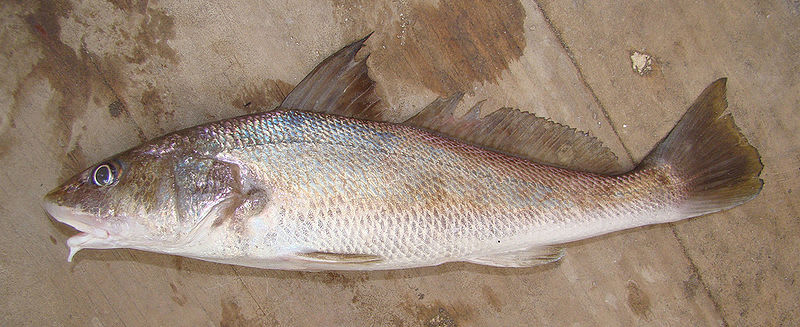
Taxonomy
- Kingdom
- Animalia
- Phylum
- Chordata
- Class
- Actinopterygii
- Order
- Perciformes
- Family
- Sciaenidae
- Genus
- Menticirrhus
- Species
- americanus
Habitat
Southern kingfish primarily inhabit coastal waters, bays, and estuaries with sandy or muddy bottoms along the western Atlantic Ocean, from the southeastern United States to northern South America. They prefer shallow areas with temperatures between 15-25°C and are often found near beaches and inlets. This species avoids very deep waters, staying in regions with moderate currents.
Diet
Southern kingfish feed mainly on small crustaceans like shrimp and crabs, polychaete worms, and bivalves such as clams. They use their chin barbel to probe the sediment while bottom-feeding, often in shallow waters. Feeding activity is most active during the day, particularly at high tide.
Behavior
Southern kingfish are schooling fish that form loose groups for protection and feeding, often burrowing into the sand to hide from predators. They are primarily diurnal, active during daylight hours, and exhibit migratory behavior seasonally to follow food sources. They are not strongly territorial but may compete for prime feeding spots.
Fishing
Southern kingfish, a favored sport fish in coastal waters from the southeastern United States to northern South America, provide exciting bottom-fishing opportunities that support conservation through angler-funded programs like license fees and habitat restoration. Employ bottom-fishing techniques such as using a simple Carolina rig or fish finder rig to keep bait on the seafloor, casting from surf, piers, or boats to target their schooling behavior. Use light to medium spinning tackle with 6-10 pound test monofilament line, a 7-9 foot rod for sensitivity, and size 1-4 hooks to handle their feisty runs; pair this with sinkers like pyramid weights to hold bottom in currents. Effective baits include fresh shrimp, sand fleas, bloodworms, or small crabs to mimic their diet of crustaceans and worms, while artificial lures like 1-2 inch jigs can entice strikes during active feeding periods. The best seasons are spring through fall when water temperatures range from 15-25°C, with peak activity during daylight hours, especially around high tide when they forage aggressively in shallow areas. Target them in bays, estuaries, and near sandy or muddy beaches with moderate currents, focusing on depths of 5-30 feet where they school and burrow for protection. Record sizes reach up to 61 cm in length and 2 pounds 13 ounces, with the IGFA all-tackle world record at 3 pounds 1 ounce, showcasing their potential for rewarding catches. Conservation measures, such as bag limits and size slots in many regions, are effective tools for maintaining stable populations, as evidenced by their Least Concern status from the IUCN, with angler-supported stocking and catch-and-release practices ensuring these fisheries thrive and protect vital coastal ecosystems.
Conservation Status
Listed as Least Concern by IUCN.