
Overview
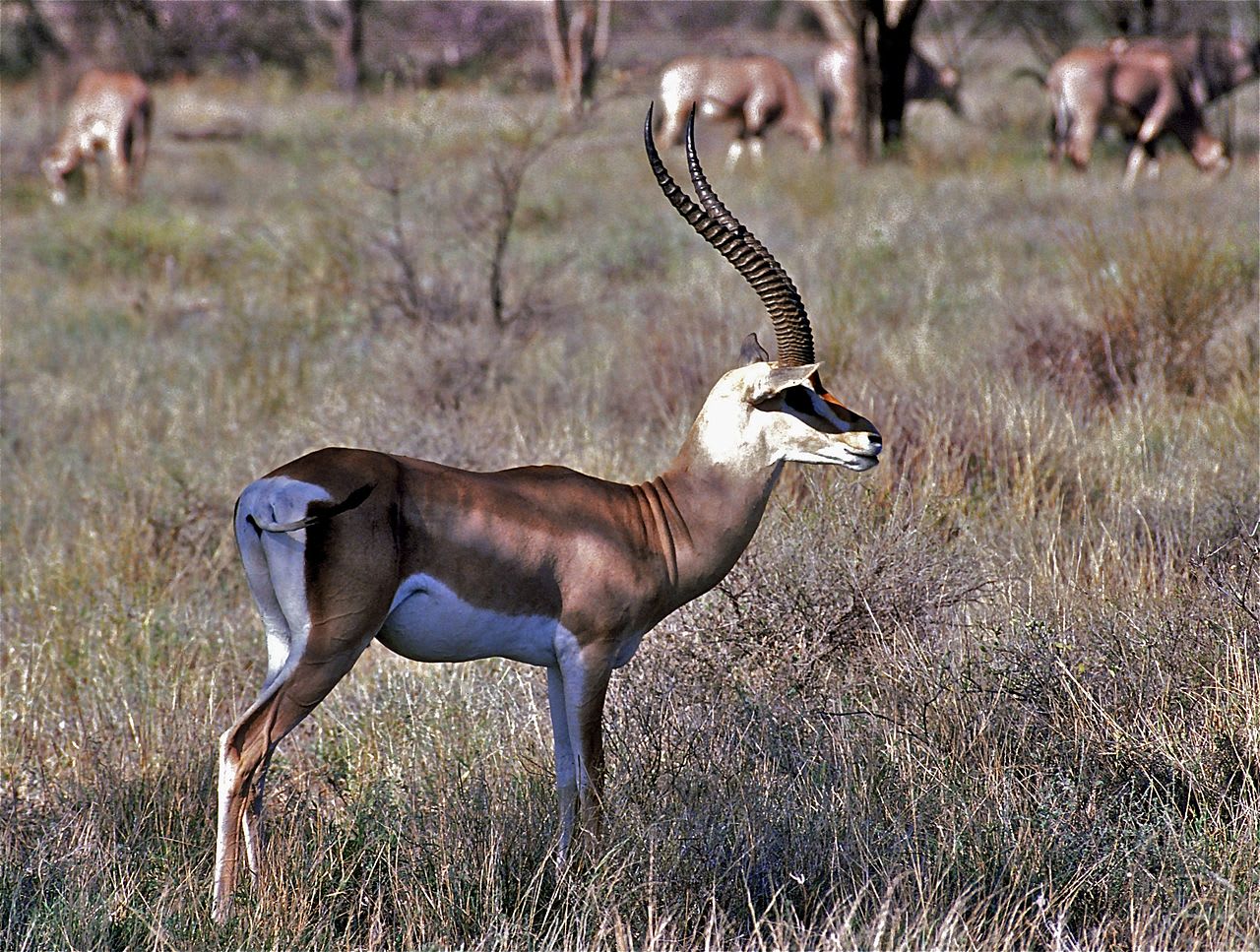
The Southern grant's is the typical form. It has the longest horns of any Grant, or of any other gazelle, and typically they are widely spread. The general body color is light cinnamon or fawn. The flank band is faint, but the nose spot and pygal (rump) stripes are well-defined. Differing somewhat from other southern Grants is the serengetae form of southern Kenya, in which the white rump patch is divided by a narrow brown stripe that reaches the root of the tail, and the horns diverge gradually and are not lyrate in shape. It is rather similar to the Peters gazelle in these respects.
Taxonomy
- Kingdom
- Animalia
- Phylum
- Chordata
- Class
- Mammal
- Order
- Artiodactyla
- Family
- Bovidae
- Genus
- Nanger
- Species
- Nanger granti
Habitat
Plains and scrub grasslands. Distribution- Northeastern and central Tanzania, and Kenya south of the equator. For convenience in record keeping, we follow Rowland Ward in using the equator to separate the southern Grant from the northern Grant. (This is a change from earlier editions.)
Diet
Primarily a grazer but will browse when necessary.
Behavior
They are migratory animals, but travel in the opposite direction of most of the other ungulates, such as Thomson's gazelles, zebras, and wildebeest, which are more water dependent. They can subsist on vegetation in waterless, semiarid areas, where they face little competition.
Hunting
Hunting methods will vary based on topography of the specific area, but generally they are pursued through spot and stalk methods, glassing from vantage points and then pursuing a herd containing a desired male. Hunters should be prepared for potentially long shots. They can be found out in agricultural fields, plains, and mixed topography.
Conservation Status
Listed as Least Concern by IUCN.