
Overview
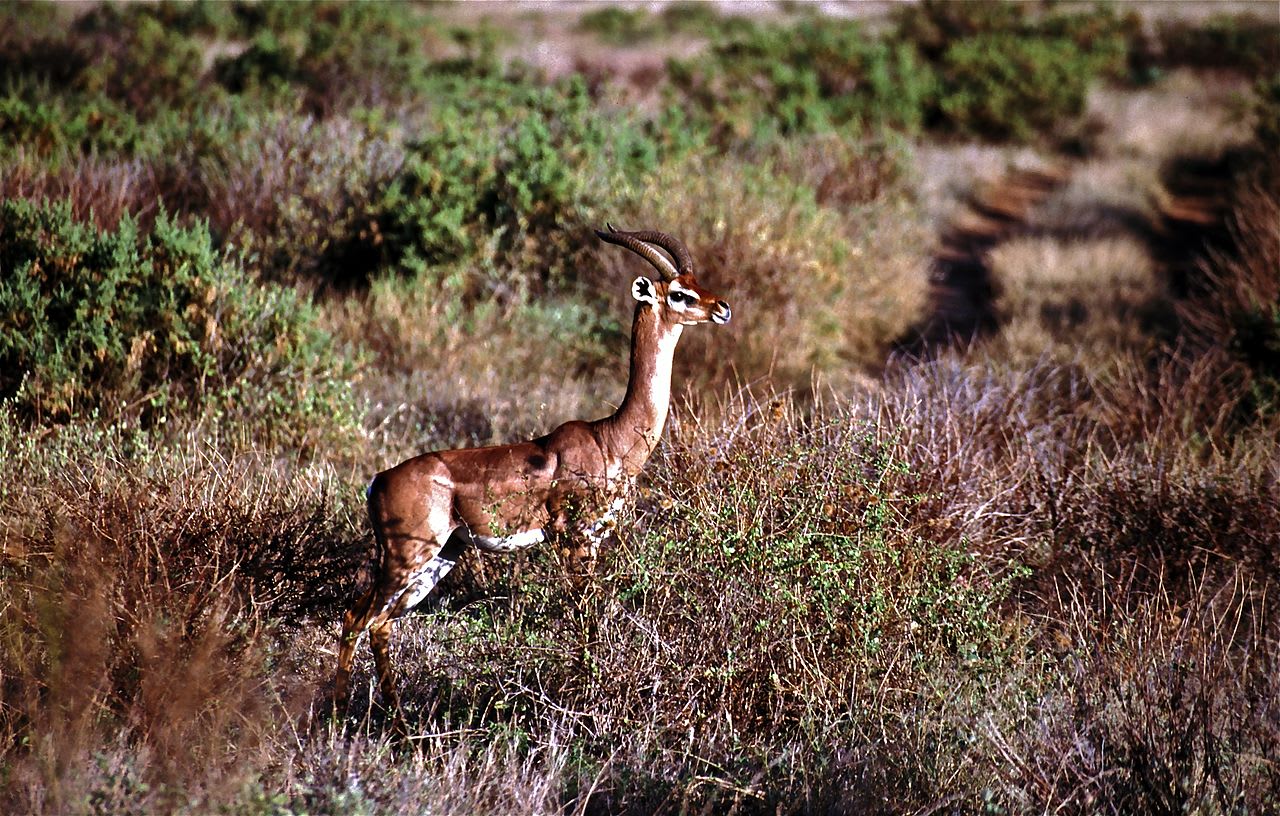
Slightly smaller than the northern gerenuk, with a somewhat shorter neck. The general color is darker and a little redder, and there is more contrast between the darker back and lighter flanks. The white area on the back of the rump is larger. The knee tufts are said to be black rather than brown but, in fact, they can vary from light brown to black within a given area.
Taxonomy
- Kingdom
- Animalia
- Phylum
- Chordata
- Class
- Mammal
- Order
- Artiodactyla
- Family
- Bovidae
- Genus
- Litocranius
- Species
- Litocranius walleri
Habitat
Found in areas with woody vegetation, especially dry, flat thornbush thickets. Distribution- The southern edge of Ethiopia, east of the Omo River and south and west of the Webi Shebeli River; east of the Rift Valley in Kenya and northern Tanzania; and southern Somalia west of the Webi Shebeli River.
Diet
This animal both grazes and browses.
Behavior
The gerenuk is a diurnal animal (active mainly during the day), though it typically stands or rests in shade during the noon. Foraging and feeding is the major activity throughout the day; females appear to spend longer time in feeding. The gerenuk may expose itself to rain, probably to cool its body. The social structure consists of small herds of two to six members. Herds typically comprise members of a single sex, though female herds additionally have juveniles. Some males lead a solitary life.
Hunting
The southern gerenuk can be hunted in Masailand, northern Tanzania. Both the northern and southern gerenuk can be hunted in the lowlands of Ethiopia. The southern gerenuk can be found in the south of Ethiopia, east of the Omo river.
Conservation Status
Listed as Near Threatened by IUCN, referring to the overall Gerenuk species.