
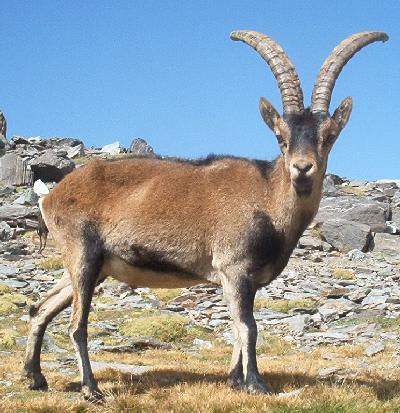
Overview
Smaller and lighter in color in comparison to the Beceite and Gredos ibex, but larger and darker than the Ronda ibex. Horn size and shape vary considerably from place to place, with those from the Sierra Nevada generally the largest. Horns from Tejada-Almijara, tend to form a circle with the tips growing toward the neck like a mouflon.
Taxonomy
- Kingdom
- Animalia
- Phylum
- Chordata
- Class
- Mammal
- Order
- Artiodactyla
- Family
- Bovidae
- Genus
- Capra
- Species
- Capra pyrenaica
Habitat
This ibex inhabits rocky arid cliffs, often in close proximity to humans and nearby farmland. Distribution- The mountains and reserves of Tejada, Almijara, Sierra Nevada, Lujar, Cazorla, and Muela de Cortes in southeastern Spain.
Diet
Primarily browses but will graze on grasses and forbs as available.
Behavior
Males and females remain in separate herds outside of the breeding season, which takes place in November and December. Yearlings will separate from their mothers when new offspring are born, with female yearlings returning to the female herds and male yearlings leaving their mothers permanently for male-only groups. When Spanish ibex spot predators, they stand erect with ears and head pointing towards the predator, followed by an alarm call, sounding like a high-pitched whistle, to warn other ibex nearby. These animals routinely escape predators by running for the cover of rocky cliffs.
Hunting
Hunting methods will vary based on topography of the specific area, but generally ibex are pursued through spot and stalk methods, glassing from vantage points and then pursuing a herd containing a desired male. Hunters should be in good physical condition and be prepared for precipitous terrain and potentially long shots.
Conservation Status
Listed as Least Concern by IUCN.