
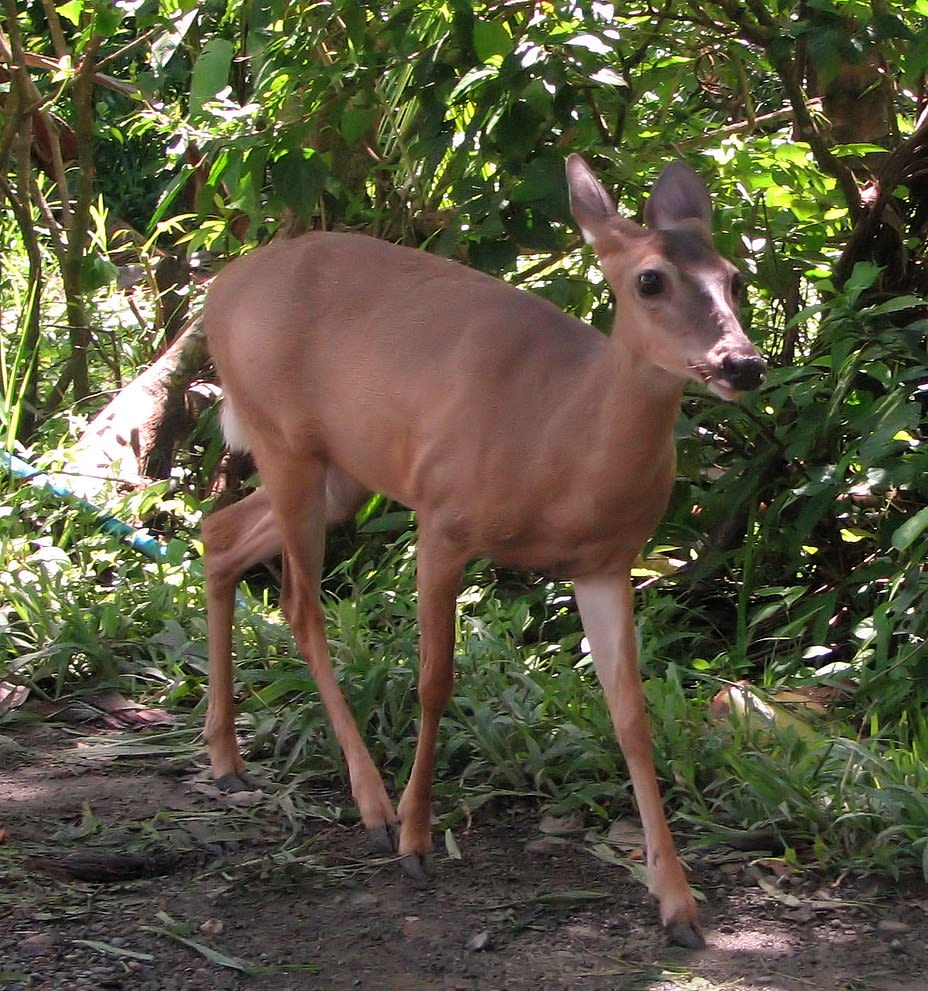
Taxonomy
- Kingdom
- Animalia
- Phylum
- Chordata
- Class
- Mammal
- Order
- Artiodactyla
- Family
- Cervidae
- Genus
- Odocoileus
- Species
- Odocoileus virginianus
Habitat
This subspecies inhabits a variety of environments in South America, including tropical forests, savannas, and agricultural edges in countries like Brazil and Venezuela. They prefer areas with dense cover for hiding and proximity to water sources, avoiding open plains where they are more exposed to predators. Terrain often includes hilly or forested regions for foraging and bedding.
Diet
They primarily consume leaves, twigs, fruits, and grasses, acting as browsers and grazers to adapt to seasonal availability. Feeding occurs mainly at dawn and dusk when they are most active, helping them avoid predators while maximizing nutrient intake. In agricultural areas, they may eat crops like corn or soybeans, leading to human conflicts.
Behavior
These deer are crepuscular, most active at dawn and dusk, which helps them forage safely. They form small family groups led by females, while males are mostly solitary except during the rutting season when they become territorial and compete for mates. Notable behaviors include flagging their tail as a warning signal and bounding in a zigzag pattern to evade predators.
Hunting
South American white-tailed deer, specifically the subspecies Odocoileus virginianus gymnotis, are hunted using spot-and-stalk methods in their preferred habitats of tropical forests and savannas, with rifle hunting being the primary approach for accuracy at medium ranges; recommended calibers include .243 Winchester, .270 Winchester, and .30-06 Springfield to ensure humane, one-shot kills, while bow hunters opt for compound bows with fixed broadhead arrows for close-range shots. The best hunting season aligns with the rut in autumn, typically from May to July in the Southern Hemisphere, when bucks are more active and easier to locate in hilly or forested regions. Trophy criteria emphasize antler size, beam length, and points, with record book potential in Safari Club International (SCI) for outstanding specimens exceeding 50 cm in spread. Legal hunting is available on private game ranches in Argentina and in select regulated areas of Venezuela, where it plays a key role in conservation by generating revenue from hunting fees to fund habitat protection and population management programs, demonstrating how regulated harvest helps maintain stable deer numbers and counters threats like habitat loss, much like successful models in North America.
Conservation Status
The IUCN classifies the white-tailed deer as Least Concern overall, but the South American subspecies faces population declines due to habitat loss and hunting pressure. Major threats include deforestation for agriculture and road accidents in human-altered landscapes.