
Overview
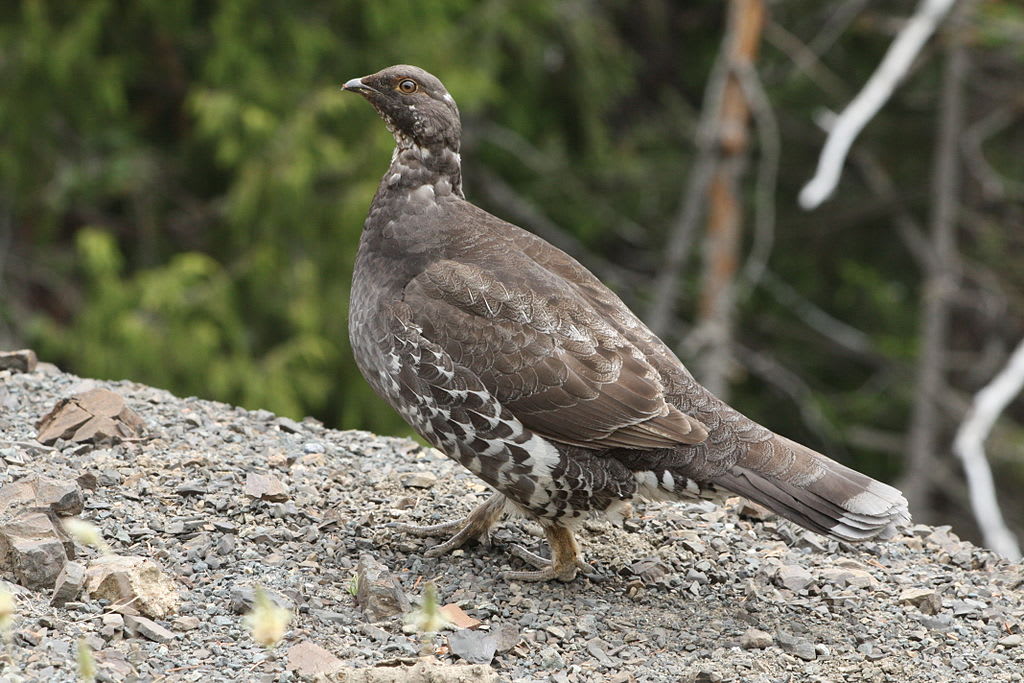
Adults have a long square tail, light gray at the end. Adult males are mainly dark with a yellow throat air sac surrounded by white, and a yellow wattle over the eye during display. Adult females are mottled brown with dark brown and white marks on the underparts.
Taxonomy
- Kingdom
- Animalia
- Phylum
- Chordata
- Class
- Bird
- Family
- Phasianidae
- Genus
- Dendragapus
- Species
- fuliginosus
Habitat
Their breeding habitat is the edges of conifer and mixed forests in mountainous regions of western North America, from southeastern Alaska and Yukon south to California. Their range is closely associated with that of various conifers. The nest is a scrape on the ground concealed under a shrub or log. They are permanent residents but move short distances by foot and short flights to denser forest areas in winter, with the odd habit of moving to higher altitudes in winter.
Diet
These birds forage on the ground, or in trees in winter. In winter, they mainly eat fir and douglas-fir needles, occasionally also hemlock and pine needles; in summer, other green plants (Pteridium, Salix), berries (Gaultheria, Mahonia, Rubus, Vaccinium), and insects (particularly ants, beetles, grasshoppers) are more important. Chicks are almost entirely dependent on insect food for their first ten days.
Behavior
Males sing with deep hoots on their territory and make short flapping flights to attract females. Females leave the male's territory after mating.
Hunting
Upland game bird most effectivly hunted with a bird dog. The Sooty grouse is one of wild game bird hunters' more challenging prey because it generally requires hiking into higher mountain areas to find and pursue.
Conservation Status
Listed as Least Concern by IUCN.