
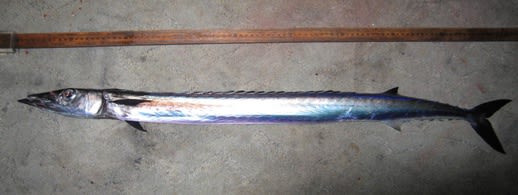
Taxonomy
- Kingdom
- Animalia
- Phylum
- Chordata
- Class
- Actinopterygii
- Order
- Perciformes
- Family
- Gempylidae
- Genus
- Thyrsites
- Species
- atun
Habitat
Snake mackerel primarily inhabit pelagic waters of the open ocean, from 100 to 500 meters depth in cool temperate regions. They prefer the southern hemisphere's currents around South Africa, Australia, and South America, often migrating seasonally to follow food sources. These fish are adapted to deep, offshore environments with strong oceanic flows.
Diet
Snake mackerel feed mainly on smaller fish like lanternfish, squid, and crustaceans, capturing them through swift, predatory strikes. They are active hunters in the open water, often feeding at night in the upper pelagic zones. Their feeding behavior involves chasing prey in schools or individually.
Behavior
Snake mackerel are typically solitary or form loose schools, exhibiting migratory patterns to track prey and seasonal changes. They are primarily nocturnal, hunting actively under low light conditions, and show territorial behavior when feeding. These fish are agile swimmers, using their streamlined bodies to evade threats in open waters.
Fishing
Target snake mackerel in the pelagic waters of the southern hemisphere, including areas like South Africa, Australia, and South America, at depths from 100 to 500 meters where they follow oceanic currents and prey. Use trolling or deep jigging techniques with heavy-duty tackle, such as stout rods rated for 30-50 lb test, large reels with strong drag systems, and wire leaders to handle their sharp teeth; effective baits and lures include live bait like lanternfish or squid, and metal jigs or flashy lures that mimic small fish and crustaceans. The best season is summer during their spawning migrations, with optimal fishing times at night when they are most active hunters. Anglers should focus on these deep, offshore environments to increase success, aiming for fish that can reach up to 140 cm in length and weigh as much as 14 lbs 3 oz, with the IGFA all-tackle record underscoring their status as a challenging sport fish. Conservation-wise, while snake mackerel are listed as Not Evaluated by the IUCN, practicing catch-and-release helps sustain populations, and angler-funded programs through license fees support broader oceanic habitat protection and research efforts.
Conservation Status
Listed as Not Evaluated by IUCN.