
Overview
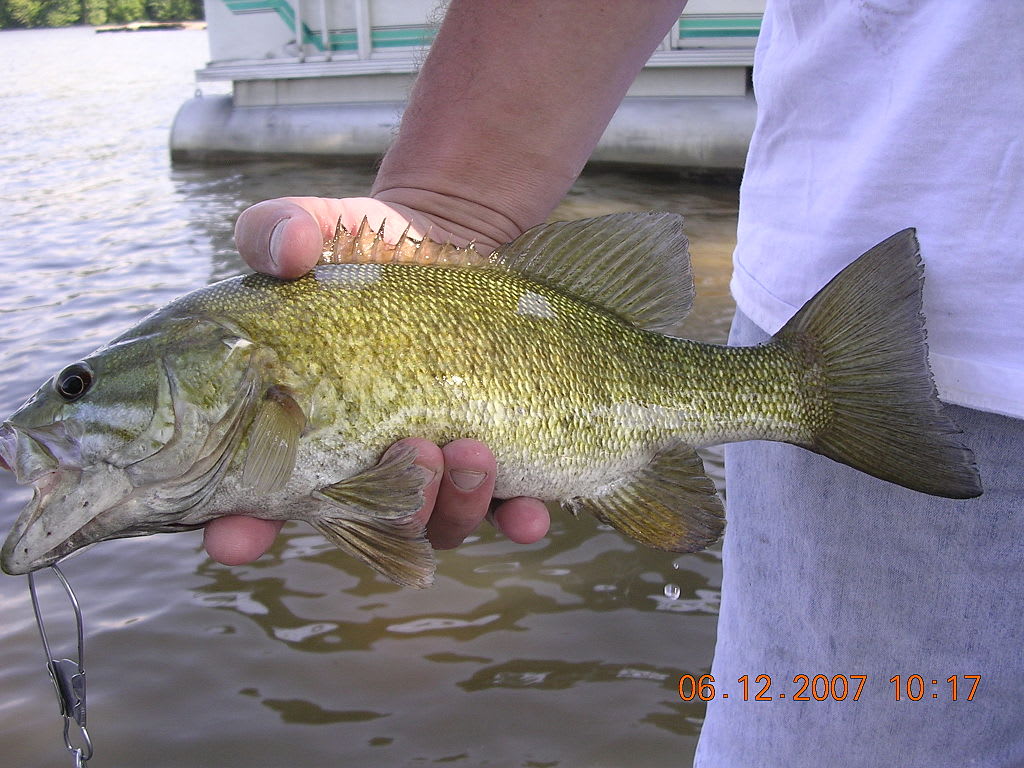
The smallmouth also has faint bars on the body (prominent in the young), while the largemouth has a fairly wide streak of oval or diamond shaped markings or blotches down the midline of the sides. In either species the colors may vary and the markings may be inconspicuous or absent in individuals based on time of year and various biological factors. Generally, the smallmouth has bars radiating back from the eyes, and though similar bars may be present in individuals of other species, including the largemouth, they seem to be more prominent and more consistently present in the smallmouth. The eyes are red or orangish. In young smallmouths there is a distinctive band of orange at the base of the tail. This is followed by a black band with the tip of the tail being white or yellow.
Taxonomy
- Kingdom
- Animalia
- Phylum
- Chordata
- Class
- Actinopterygii
- Order
- Cypriniformes
- Family
- Centrarchidae
- Genus
- Micropterus
- Species
- dolomieu
Habitat
The smallmouth bass is native to the eastern half of the U.S.A. and southeastern Canada from Manitoba and Quebec south to the Tennessee River system in Alabama and west to eastern Oklahoma. It has been widely transplanted so that today it occurs in almost every state and many other countries. This bass thrives in most freshwater environments.
Diet
Insects, Frogs, Small Fish, Crayfish, Crustaceans, Zooplankton, Minnows, Shad, Lizards, Sunfish, Perch.
Behavior
They prefer deeper water than the largemouth and areas of clear, fast flowing streams and pools with gravel/rubble bottom. In waters cohabited by both smallmouth and largemouth, the largemouth bass will spawn a little earlier due to the fact that the shallower nesting sites they choose in protected areas with emergent vegetation warm to the optimum temperature sooner than the deeper, rockier sites chosen by the smallmouths.
Fishing
There are many who say that the smallmouth bass is gamer than the largemouth. There is no doubt that it rivals the largemouth in popularity
Conservation Status
Listed as Least Concern by IUCN.