
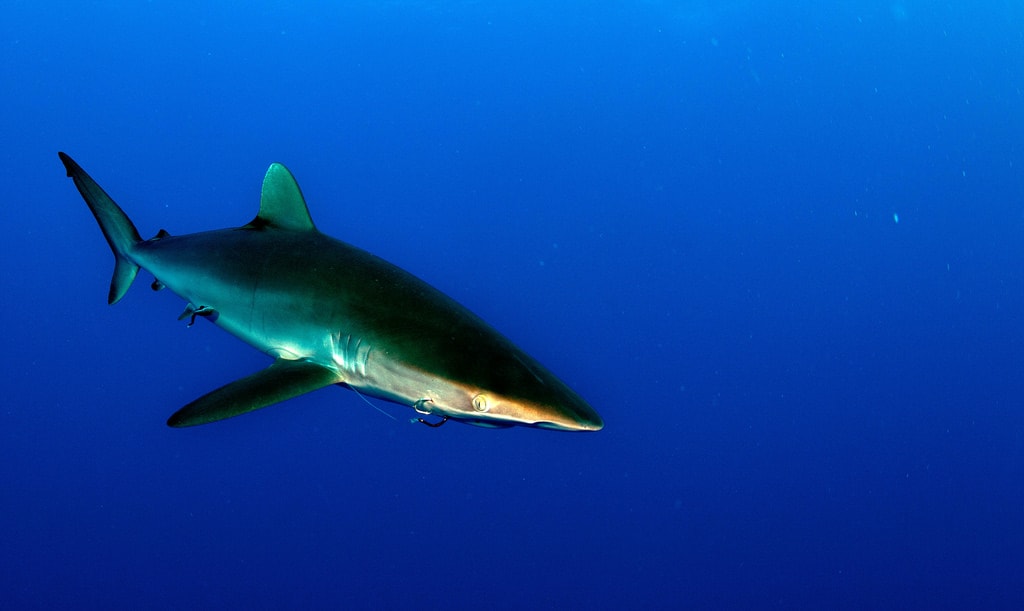
Taxonomy
- Kingdom
- Animalia
- Phylum
- Chordata
- Class
- Chondrichthyes
- Order
- Carcharhiniformes
- Family
- Carcharhinidae
- Genus
- Carcharhinus
- Species
- falciformis
Habitat
Silky sharks primarily inhabit warm, tropical and subtropical oceanic waters, often in pelagic environments from the surface down to depths of about 500 meters. They prefer areas near continental shelves, oceanic islands, and open sea, with a wide distribution across the Atlantic, Indian, and Pacific Oceans. These sharks are highly migratory, following currents and prey availability.
Diet
Silky sharks feed mainly on bony fish such as mackerel and tuna, as well as squid and occasionally smaller sharks or rays. They are opportunistic predators that hunt in schools, using speed and agility to chase down prey. Feeding activity peaks at dawn and dusk in open waters.
Behavior
Silky sharks are highly social and often form large schools, especially juveniles, which provides protection and aids in hunting. They are active both day and night but tend to be more aggressive during feeding frenzies, and they exhibit migratory behavior over long distances following ocean currents. While not strongly territorial, they can become bold around food sources, sometimes approaching boats.
Fishing
Targeting silky sharks offers anglers an exciting challenge in offshore big-game fishing, supporting conservation through regulated recreational efforts that fund marine habitat protection via license fees and excise taxes. Use trolling with heavy tackle as the best technique, deploying live or dead bait like mackerel, squid, or bonito to mimic their primary prey, or artificial lures that simulate schooling fish; chumming can also attract schools for added action. Opt for heavy-duty conventional reels with 50-80 pound test line, stout rods rated for big game, and wire leaders to handle their sharp teeth and powerful runs, ensuring safe handling for catch-and-release. The best seasons are year-round in tropical and subtropical waters, with peak activity at dawn and dusk when feeding frenzies occur, targeting pelagic habitats near continental shelves, oceanic islands, or open sea in the Atlantic, Indian, and Pacific Oceans at depths from the surface to 500 meters—focus on areas with strong currents and baitfish concentrations for higher success. The IGFA all-tackle record stands at 762 pounds 12 ounces, caught in 2021, highlighting their impressive size potential up to 4 meters. Conservation-wise, silky sharks are listed as Vulnerable by the IUCN due to overfishing, so adhere to effective management tools like catch-and-release practices, slot limits, and seasonal closures in many regions, which are angler-funded initiatives that help maintain healthy populations and protect migratory routes through programs like NOAA's shark conservation efforts.
Conservation Status
Listed as Vulnerable by IUCN.