
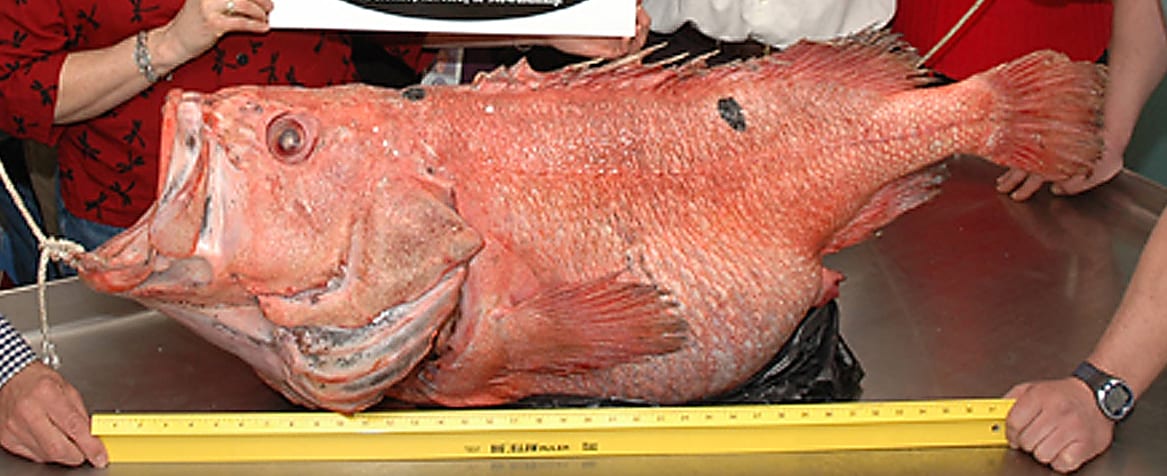
Taxonomy
- Kingdom
- Animalia
- Phylum
- Chordata
- Class
- Actinopterygii
- Order
- Salmoniformes
- Family
- Sebastidae
- Genus
- Sebastes
- Species
- borealis
Habitat
Shortracker rockfish inhabit deep waters of the North Pacific Ocean, typically from 100 to 900 meters depth over rocky or boulder-strewn substrates. They prefer cold, marine environments along continental shelves and slopes, commonly found around Alaska, the Aleutian Islands, and extending south to California.
Diet
Shortracker rockfish primarily feed on small fish, squid, and crustaceans such as shrimp and crabs. They are ambush predators that hunt near the seafloor, often at dusk or night when prey is more active.
Behavior
Shortracker rockfish are generally solitary and sedentary, spending most of their time hiding among rocks or on the seafloor to avoid detection. They exhibit minimal territorial behavior but may form loose aggregations in deeper waters for feeding. This species is not highly active, often remaining motionless during the day and becoming more mobile at night.
Fishing
Targeting the Shortracker rockfish in the deep waters of the North Pacific, including Alaska's Aleutian Islands and extending south to California, requires specialized deep-sea techniques like bottom fishing with jigs or bait rigs to reach depths of 100-900 meters over rocky substrates—focus on areas with boulders and continental slopes for the best results. Use heavy-duty tackle such as a stout rod rated for 20-50 pound test line, a strong reel with deep-line capacity, and weighted setups like sinkers or downriggers to get your bait down quickly; effective baits and lures include squid, shrimp, or crab imitations that mimic their natural diet of small fish and crustaceans, presented near the seafloor for optimal strikes. The best season is year-round in many areas, but prime times are during the spring and summer when they are more active, with evening or night fishing yielding the highest success due to their ambush predation habits. Anglers should aim for IGFA records, with the largest Shortracker rockfish weighing up to 41 pounds 1 ounce, showcasing the thrill of this deep-water challenge. Conservation-wise, recreational fishing for species like the Shortracker rockfish supports aquatic habitat protection through license fees and taxes, and while this species is not evaluated by the IUCN, effective management tools such as slot limits and catch-and-release practices in certain regions help maintain stable populations, ensuring sustainable fisheries for future generations.
Conservation Status
Listed as Not Evaluated by IUCN.