
Overview
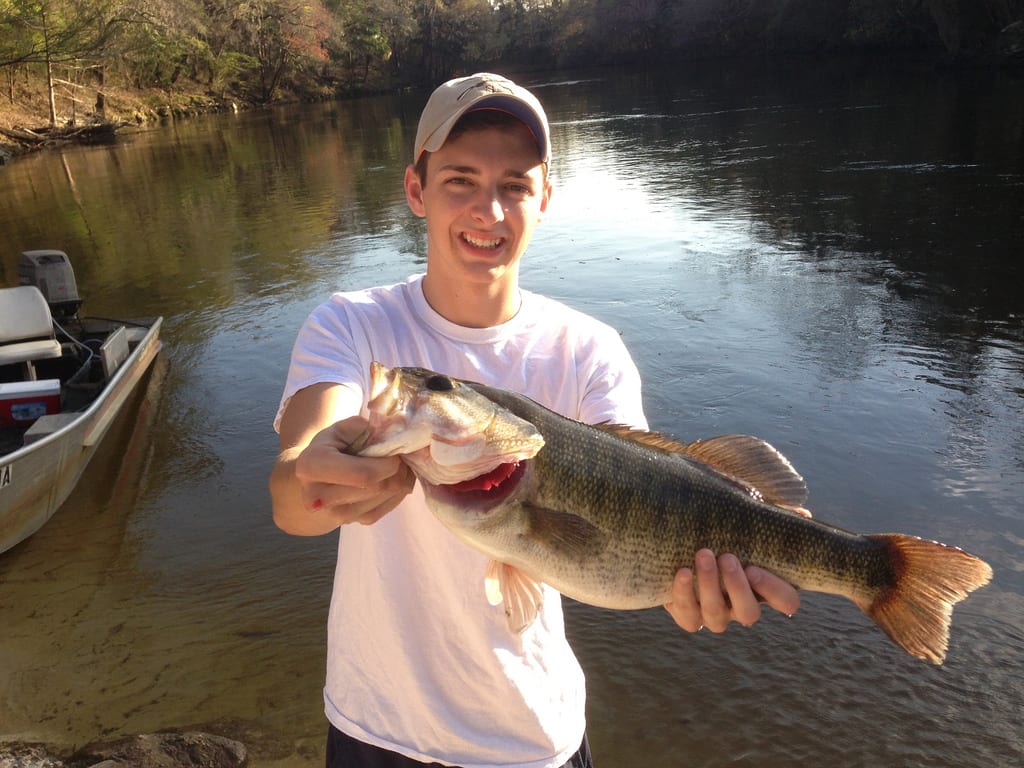
Over the past 40 years, the shoal bass has been referred to as the Redeye Bass, M. coosae, as an undescribed subspecies or variety of the Redeye Bass, or as an undescribed species. In a paper written by James D. Williams and George H. Burgess, A New Species of Bass, Micropterus cataractae, the confusion was finally clarified. After examining the records for the “Redeye Bass” at IGFA, it was determined that all of the existing records are Shoal Bass, Micropterus cataractae. All of the Redeye Bass records have been transferred to the new designation of Shoal Bass. The Shoal Bass coloration is olive green to dark olive to almost black, a dusky to black blotch is present on the posterior portion of the opercle and another one right before the tail. Three diagonal dark lines are present laterally on the head. The iris is typically bright red.
Taxonomy
- Kingdom
- Animalia
- Phylum
- Chordata
- Class
- Actinopterygii
- Order
- Cypriniformes
- Family
- Centrarchidae
- Genus
- Micropterus
- Species
- cataractae
Habitat
It inhabits shoal areas of rivers and large creeks throughout its range.
Diet
Shoal bass primarily feed on small fish such as minnows and shiners, as well as crayfish and aquatic insects. They are ambush predators that lie in wait among rocks and shoals, striking quickly at prey. Feeding is most active during dawn and dusk in their river habitats.
Behavior
Although the Shoal Bass has been most often confused with the Redeye Bass, it is most similar to the Spotted Bass, M. punctulatus. It differs from the Spotted Bass by the absence of teeth on its tongue. The Shoal Bass also has more lateral lines scales (usually 67-81, not 59 to 70), more rows of scales above (usually 8 to 10, not 6 to 9) and below (usually 15 to 21, not 12 to 15) the lateral line and more caudal peduncle scales than the Spotted Bass. The color pattern of adult Shoal Bass is characterized by the presence of 10 to 15 midlateral and 6 to 8 supralateral dark vertical bars along the sides, these bars, which are also present in juveniles, easily distinguish the Shoal Bass from Spotted Bass. The Redeye Bass and has an oval to rectangular patch of teeth on the tongue, fewer lateral line scales (usually 62-73, not 67-81) and fewer scale rows above (usually 7 to 9, not 8-10) and below (usually 13 to 16, not 15-21) the lateral line.
Fishing
The American Fisheries Society Endangered Species Committee lists the Shoal Bass as a species of Special Concern. With the continuing loss of habitat favored by the Shoal Bass, this species will undoubtedly continue to decline
Conservation Status
Listed as Near Threatened by IUCN.