
Overview
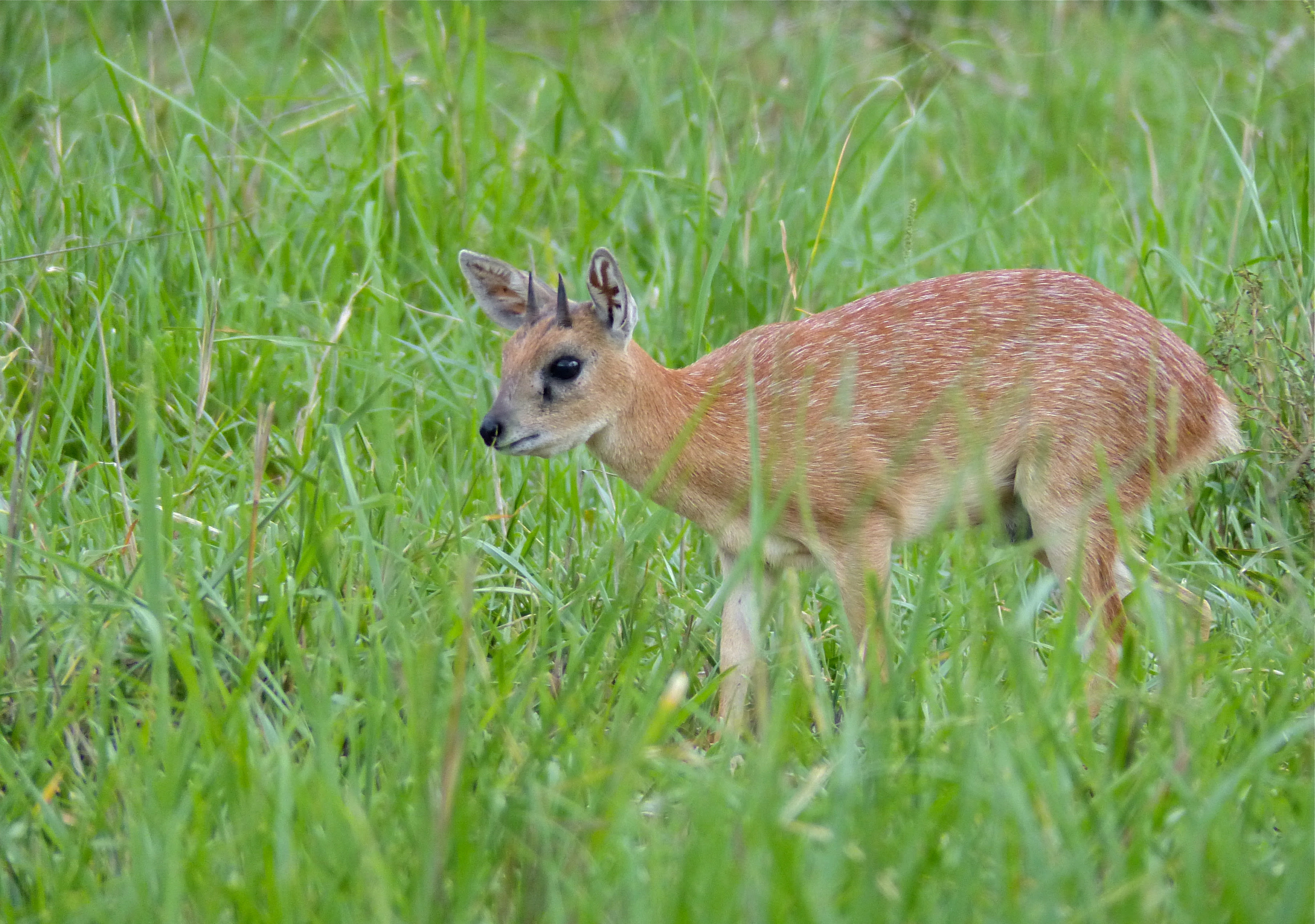
A very small antelope, with its rump somewhat higher than its shoulders, and a wiry coat. (It is a little smaller than a Cape grysbok or a steinbok and has much shorter horns.) The general color is bright tawny rufous, sprinkled with white hairs on the upper parts to give a grizzled appearance. The underparts are buffy white. The outside of the legs is yellowish brown, as is the face. There is a narrow white stripe over the eye, and a short, dark nose stripe. The ears are large and the tail is very short. There are no false hoofs (like the steenbok, but unlike the Cape grysbok). The horns (males only) are very short (shorter than the ears), cone-shaped, and ringed only at the base. Females are similar to males, but slightly larger and without horns.
Taxonomy
- Kingdom
- Animalia
- Phylum
- Chordata
- Class
- Mammal
- Order
- Artiodactyla
- Family
- Bovidae
- Genus
- Raphicerus
Habitat
Low, thick scrub and grass, often at the base of rocky ridges or kopjes. Distribution- Western and southern Tanzania; Zambia, except west of the Zambezi; Malawi; extreme northeastern Botswana; Zimbabwe; Mozambique; northern and eastern Transvaal in South Africa; and Swaziland.
Diet
Primarily browses but will also graze.
Behavior
Solitary except when mating, or a female with her offspring. The single young can be born anytime during the year, after seven months gestation. Active around sunrise and sunset and at night, lying up in thick cover or in an old aardvark hole for most of the day. Hearing is apparently good, other senses not known. Shy and secretive, it is seldom seen even where common. Prefers to hide rather than run off. When flushed, it runs crouched low to the ground through thick cover, making it difficult to observe.
Hunting
Not as nocturnal as the Cape grysbok, thus somewhat easier to hunt; nonetheless, most hunters fail to take one. Should be taken with a small caliber, a solid bullet, or a shotgun so as not to ruin the skin.
Conservation Status
Listed as Least Concern by IUCN.