
Overview
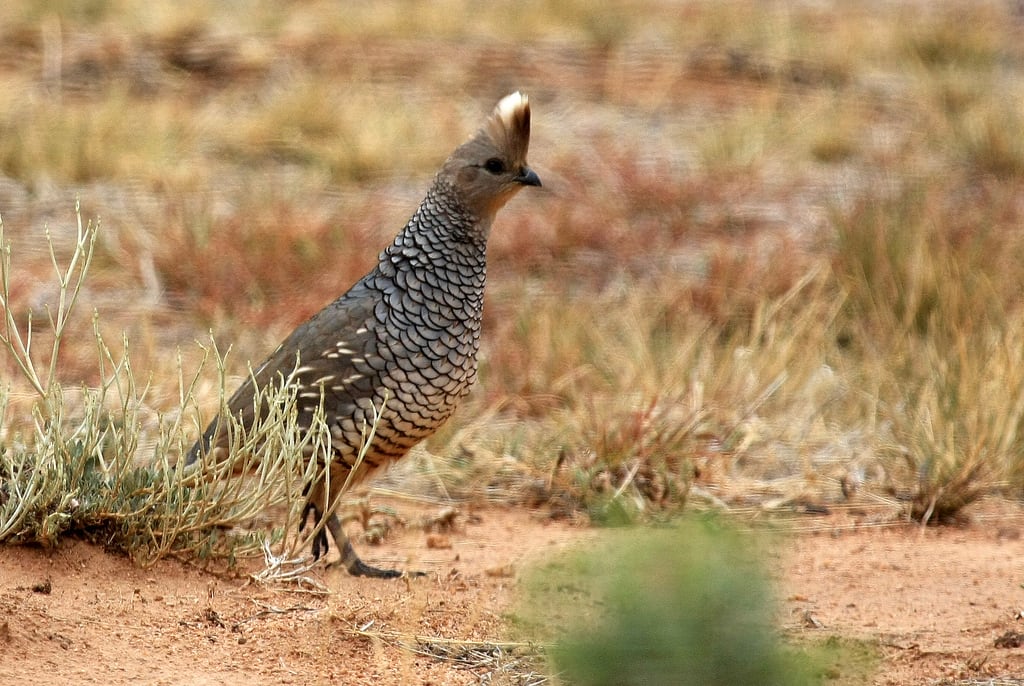
This bird is named for the scaly appearance of its breast and back feathers. Along with its scaly markings, the bird is easily identified by its white crest that resembles a tuft of cotton.
Taxonomy
- Kingdom
- Animalia
- Phylum
- Chordata
- Class
- Bird
- Family
- Odontophoridae
- Genus
- Callipepla
- Species
- squamata
Habitat
Inhabit dry, open valleys, plains, foothills, rocky slopes, draws, gullies, and canyons that have a mixture of bare ground, low herbaceous growth, and scattered brushy cover. Good scaled quail habitat is characterized by low-growing grasses with forbs and shrubs. Overall ground cover is between 10 and 50%. Trees and shrubs should be less than 6.6 feet tall. Scaled quail avoid the dense growth associated with streamsides. Transmitter-fitted scaled quail had individual home range sizes of 52 and 60 acres. Scaled quail gravitate towards structure, old homesteads and barns.
Diet
Seeds, insects, plant material, berries.
Behavior
A very social bird, living in large covey groups most of the year. Pairs are formed March through late summer-early fall. As ground dwelling bird, much of their day is consumed by evading predators. At night a roost is formed by a group of birds cricling on the ground with heads facing outwards. When threatened the bird runs from bush to bush seeking cover, as a last resort the bird will birds into a short highspeed flight. The Scaled Quail flys less readily than a Northern Bobwhite, therefore making it a less desirable bird for wingshooters hunting over dogs.
Hunting
Upland game bird most effectivily hunted with bird dogs.
Conservation Status
Listed as Least Concern by IUCN.