
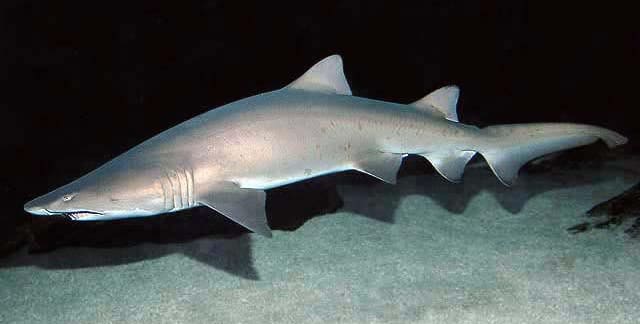
Taxonomy
- Kingdom
- Animalia
- Phylum
- Chordata
- Class
- Chondrichthyes
- Order
- Perciformes
- Family
- Odontaspididae
- Genus
- Carcharias
- Species
- taurus
Habitat
Sand tiger sharks inhabit continental shelves in temperate and subtropical waters, often in shallow coastal areas, bays, and around coral reefs or rocky outcrops. They prefer depths from the surface to about 200 meters and are commonly found over sandy or muddy bottoms. These sharks are more prevalent in regions like the western Atlantic and Indo-Pacific oceans.
Diet
Sand tiger sharks primarily feed on bony fish, smaller sharks, rays, and occasionally squid or crustaceans. They use an ambush hunting strategy, lying motionless in the water column before striking quickly. Feeding activity peaks at dawn and dusk in their preferred habitats.
Behavior
Sand tiger sharks are typically solitary but may form loose aggregations around dive sites or food sources. They exhibit a unique behavior of gulping air at the surface to maintain neutral buoyancy, allowing them to hover in place. These sharks are more active at night and can be territorial, especially during mating seasons, but they generally avoid aggressive interactions.
Fishing
Targeting the sand tiger shark as a sport fish requires adhering to strict regulations that ensure sustainable populations and support conservation efforts, such as catch-and-release practices funded by angler licenses, which help protect these vulnerable species through habitat restoration and research programs. Use heavy tackle for this powerful predator, including a sturdy rod rated for 50-80 pounds, a high-capacity reel with at least 300 yards of 50-80 pound test line, and strong leaders to handle their sharp teeth; effective baits and lures include fresh fish chunks, squid, or artificial lures that mimic their prey like swimming plugs or metal jigs, deployed via chumming or trolling to attract them from ambush positions. The best seasons are during warmer months in temperate and subtropical regions, such as summer in the western Atlantic or Indo-Pacific, with peak activity at dawn and dusk when they hunt actively in shallow coastal waters, bays, around coral reefs, or over sandy bottoms up to 200 meters deep—focus on areas like the U.S. Atlantic coast or Australian waters for higher encounter rates. The IGFA all-tackle world record stands at 661 pounds for a sand tiger shark, highlighting the potential size of these fish, with adults typically reaching 2 to 3 meters and up to 350 pounds. Always follow species-specific management tools like slot limits, catch-and-release mandates in many regions, and closed seasons to maintain healthy populations, as angler-supported programs play a key role in combating overfishing and habitat loss for this IUCN Vulnerable species.
Conservation Status
Listed as Vulnerable by IUCN.